



Industrial Ventilation Equipment.
Leak-tight, loss-free and long-lived gas transport in corrosive processes.
Efficiency is measured by the soundness of every line the emission travels, from source to atmosphere.
The efficiency of an industrial ventilation system is not decided by the choice of fan or scrubber alone, but by the soundness of every line the emission travels from its source to the atmosphere. The acidic vapours, damp exhaust gases and aggressive solvents circulating in your plant rot standard galvanised or stainless steel ducting within a short time — beginning at the seams — and lead to dangerous gas leaks inside the works. To break that destructive cycle we design the entire run in thermoplastics: polypropylene (PP), polyethylene (HDPE) and PVDF.
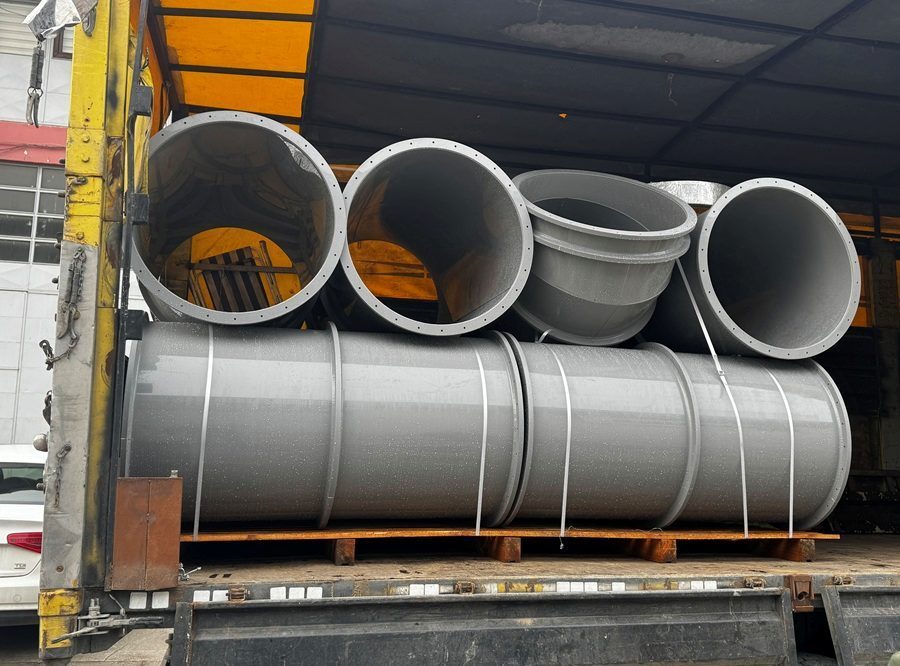
Plastic Air Ducts The main arteries — seamless thermoplastic runs
The main arteries of the system, carrying toxic and corrosive gas safely out of the plant to the treatment equipment or the atmosphere. Unlike metal ducting, they are fully corrosion-resistant to acid vapour inside and out. They are made round or rectangular according to the building and the required flow, with friction coefficients that keep aerodynamic resistance to a minimum.



- System Components
-
- Thermoplastic main runs: PP, HDPE or PVC sections selected for the chemical load and ambient temperature, formed seamlessly or joined by butt welding.
- Leak-tight connections (flange and socket): Tight flanged joints with acid-resistant EPDM or Viton gaskets, easy to fit and to dismantle.
- Dynamic supports and hangers: Support brackets with vibration-damping sliding bearings that accommodate the thermal expansion and contraction of plastic ducting.
- Global Industry Applications
-
- Surface finishing and plating plants: Complex duct networks that carry heavy hydrochloric and sulphuric vapour from the acid baths over long distances without any escape into the production hall.
- Chemical storage areas: Extraction lines that sweep enclosed stores of aggressive raw material continuously and safely with fresh air.
- Food and pharmaceutical industries: Washable, hygienic exhaust runs where any risk of metal particles or rust is unacceptable.
No corrosion and no leakage. Metal ducts eventually weep acid at their joints, at the silicone or the rivets. Plastic ducts are fused molecularly by extrusion welding, so the run becomes a single piece and stays tight for its whole life.
In fluid dynamics terms a round duct always gives the lowest pressure loss and the least turbulence. Where headroom or layout is restricted, however, rectangular ducting with aerodynamically calculated bends is used to pass through tight spaces.
So that the air is neither slow enough to let particles settle nor fast enough to overload the fan, main runs are generally designed for 10 to 15 m/s. Our engineers model the diameters that give the lowest energy consumption for your flow rate.
Yes. On outdoor routes we use UV-stabilised HDPE or special black PP instead of standard PP, removing entirely the risk of embrittlement and cracking from sunlight.
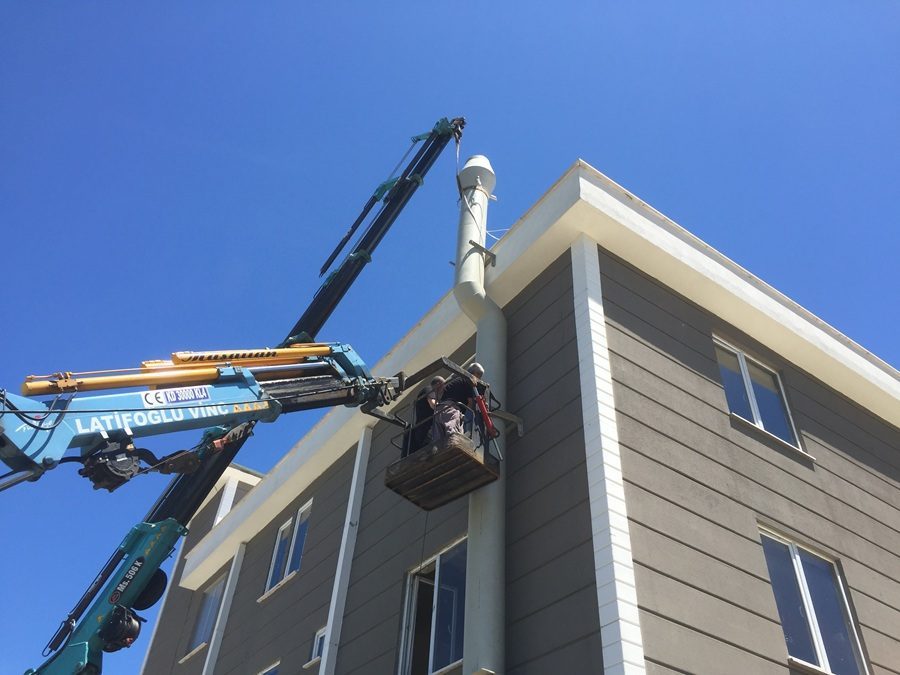
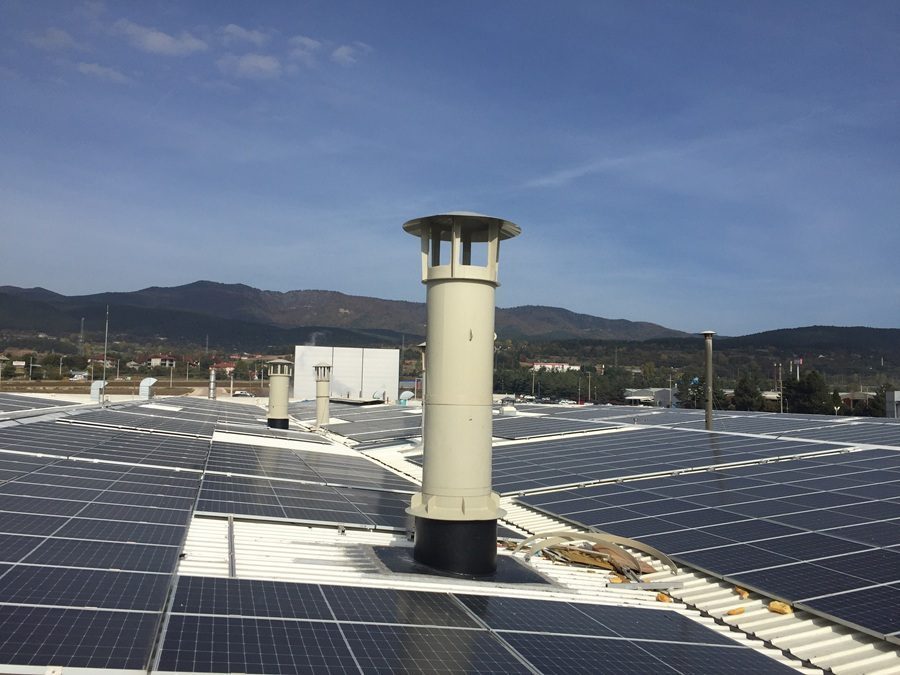
Plastic Stacks and Jet-Cap Systems Discharge stacks with a vertical throw
Vertical structures that release the cleaned air from the scrubbers, or the process exhaust, to the atmosphere at the right velocity and height. The jet-cap fitted at the top throws the gas vertically skyward without destroying its kinetic energy — unlike a classic umbrella cowl — keeps the emission from settling on the factory roof, and lets no rainwater in.


- System Components
-
- Aerodynamic jet-cap head: A high-performance discharge cowl that accelerates the exhaust through a converging cone and drains rainwater outwards through a collecting wall at its centre.
- Modular stack shell: Thermoplastic towers thickened for static and dynamic wind loads and seismic codes, or supported by an external steel frame.
- Emission sampling ports and platforms: Sampling ports and access platforms designed to environmental regulations and international standards (EPA/ISO), within the rules of workplace safety.
- Global Industry Applications
-
- Chemical and petrochemical plants: Discharge stacks that carry combustion gases and reactor emissions into the upper air without threatening anyone's health.
- Industrial boiler and furnace outlets: Points at which damp, aggressive and relatively cool waste gases are released before they can condense into acid rain.
- Odour control plants: Dispersing the residual odour from biological treatment and food plants, even after cleaning, before it reaches nearby housing.
A classic umbrella cowl pushes the gas straight down onto the roof, which both raises the back pressure on the fan and brings the corrosion onto the roof. The jet-cap, open at its centre, throws the gas upward like an arrow. When it rains, the water that enters is carried out of the stack through dedicated channels in the inner wall rather than down inside it.
Our engineers run a finite element static analysis against the stack height and the maximum wind speed at the site. Where necessary the plastic stack is seated inside an epoxy-painted steel tower or guyed to the ground with steel cables.
No. Working from the environmental impact assessment, the industrial air pollution control regulations and the prevailing wind directions, we calculate the minimum safe height at which the gas will not be drawn back down around the building.
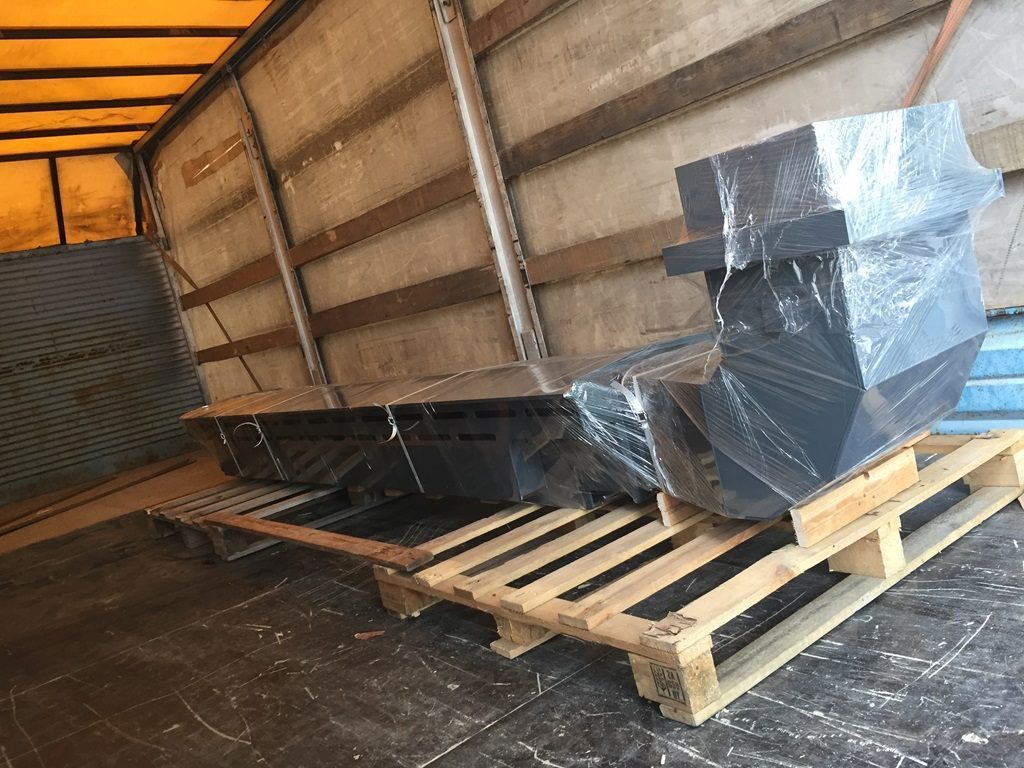
Acid Canopies The first point of contact at the source of the emission
This is where the fight against emissions begins inside the plant. Positioned directly over open acid baths, mixing reactors or local work tables, these collection units capture toxic gas at source before it mixes with the workshop air. Their ergonomic design lets people see and reach the process comfortably, while allowing no gas to escape.


- System Components
-
- PP/PVDF main body: A corrosion-free structure against heavy evaporation and direct acid splashes, with internal angles that return condensate to the bath.
- Transparent viewing and access panels: Sliding, damped front panes in transparent PVC or acrylic that do not cloud in acid vapour, so the bath stays clearly visible.
- Internal baffle system: Internal air guides that make a wide canopy draw evenly across its whole face rather than only at the centre.
- Global Industry Applications
-
- Manual and automatic plating lines: Local extraction over gold, silver, nickel and zinc dip tanks that keeps the operator's breathing zone safe.
- Laboratory sample preparation: Bench-top canopies in quality control and development areas where hazardous acid dilutions and digestions are carried out.
- Vapour cleaning and degreasing: Protective hoods that stop dense hot alkaline vapour spreading through the workshop and condensing on the ceilings.
Very directly. A canopy designed too open draws clean room air instead of process gas and demands a huge, energy-hungry fan. A correct design that extends over the edges of the bath and guides the air achieves complete capture at a far lower extraction volume.
In our design the canopy roof is not flat but angled inwards. Even when acid vapour condenses on it, the liquid runs down the walls without dripping and returns straight into the bath or into dedicated drainage channels.
Over baths more than a metre wide, an overhead canopy alone may not be enough. In those cases we integrate push-pull systems, blowing from one edge and drawing at the other, or lip exhaust channels, to create an air curtain.
Dampers and Butterfly Valves Plastic valve mechanisms for flow control and automation
The plastic valve mechanisms that control, optimise and automate flow across the ventilation network. They set the air going into the branches off the main ducts, save energy by closing the extraction on unused areas of the process, and isolate parts of the system in an emergency.


- System Components
-
- Body and blade: An axial blade that shuts off the flow, inside a polypropylene (PP) or PVC body rated for high static pressure.
- Sealing system: Elastomeric O-rings or lip seals in EPDM or Viton set into the body, giving up to 99 % — effectively bubble-tight — closure.
- Actuators: Lockable hand levers for simple duties; SCADA-compatible pneumatic or electric modulating actuators for advanced plants.
- Global Industry Applications
-
- Multiple fume hood (laboratory) systems: Systems in which, on a central exhaust fan, only the dampers of hoods whose sash is open are automatically released — variable air volume — for substantial energy savings.
- Shift-based production lines: Local control points in plating plants that close the extraction on idle baths and direct more suction to those in use.
- Safety and isolation: Automated interlocks that isolate particular zones from the rest immediately in a fire or a gas leak.
On metal dampers, seizing through corrosion is inevitable. Our plastic dampers use PTFE bearings between blade shaft and body to minimise friction, and no metal is left exposed inside. Even after years under acid they move as smoothly as on the first day.
If your process is constant — the same flow around the clock — a manual damper set once is enough. In dynamic plants where capacity changes and different baths come in and out of use, modulating electric dampers on the PLC, talking to inverter-driven fans, cut your running costs considerably.
A standard sheet-metal damper is not tight by design. A gasketed thermoplastic industrial damper, however, seats fully into the elastomeric seals around the blade and decisively stops acid fume passing into other areas, and stops the energy loss with it.
Do not leave your plant's air to chance
From capture at the source to safe release into the atmosphere, get the right engineering behind leak-tight ventilation equipment designed for your layout, with the pressure losses properly calculated.
info@yongrad.com Get technical advice for your project — contact form