



Droplet and Mist Eliminators.
Physical separation of corrosive liquid particles from the process air.
Separating the liquid phase from the gas is the heart of emission control.
In industrial ventilation and scrubbing systems, acidic or chemical droplets carried in the air stream cause lethal corrosion on fan blades, damage in the exhaust ducting and harmful emissions to atmosphere. On surface finishing lines and in heavy industry where aggressive chemicals evaporate, ordinary metals oxidise and fail within a short time. Against that destructive environment, our droplet and mist eliminators — built entirely from thermoplastics such as polypropylene (PP), polyethylene (HDPE) and PVDF to German extrusion and polymer processing standards — give your plant lifelong freedom from corrosion.
Droplet Eliminators Chevron profile vane separators
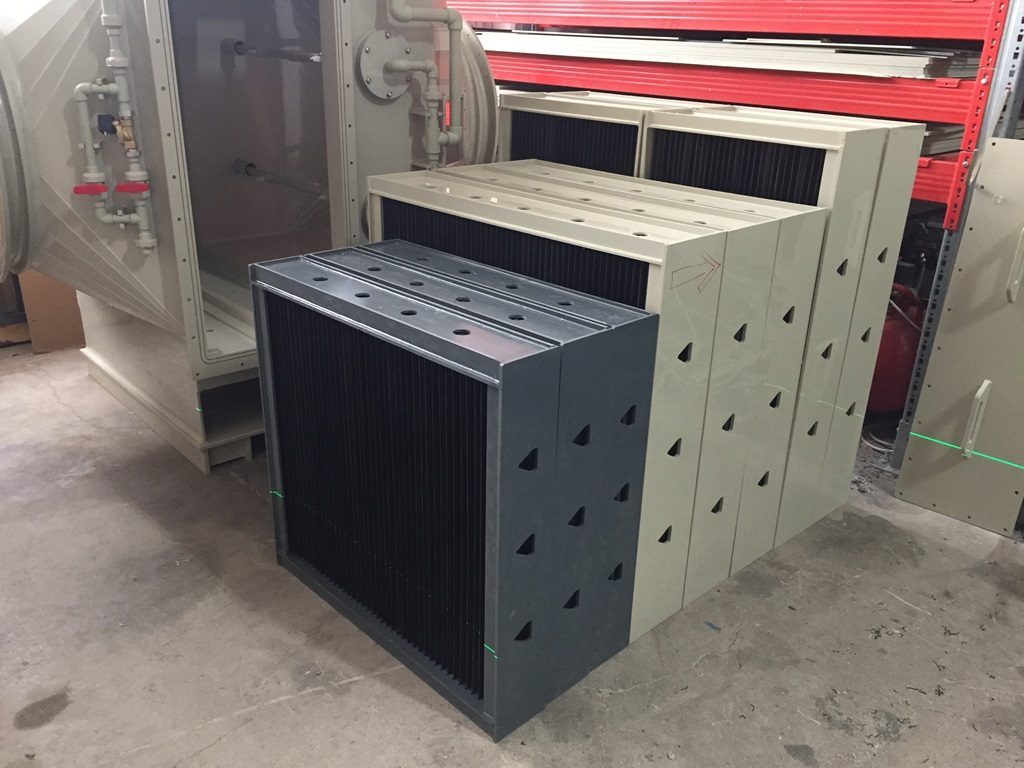
The physical removal from the air of the larger droplets carried in the gas stream, generally 20 microns and above. The system consists of aerodynamically shaped polymer vanes in a chevron profile. Passing between them, the gas is forced to change direction; the droplets, heavier than air, cannot follow that sudden change and their inertia carries them onto the vane surfaces, where they are held. The collected liquid then runs down under gravity and is drained away.
- System Components
-
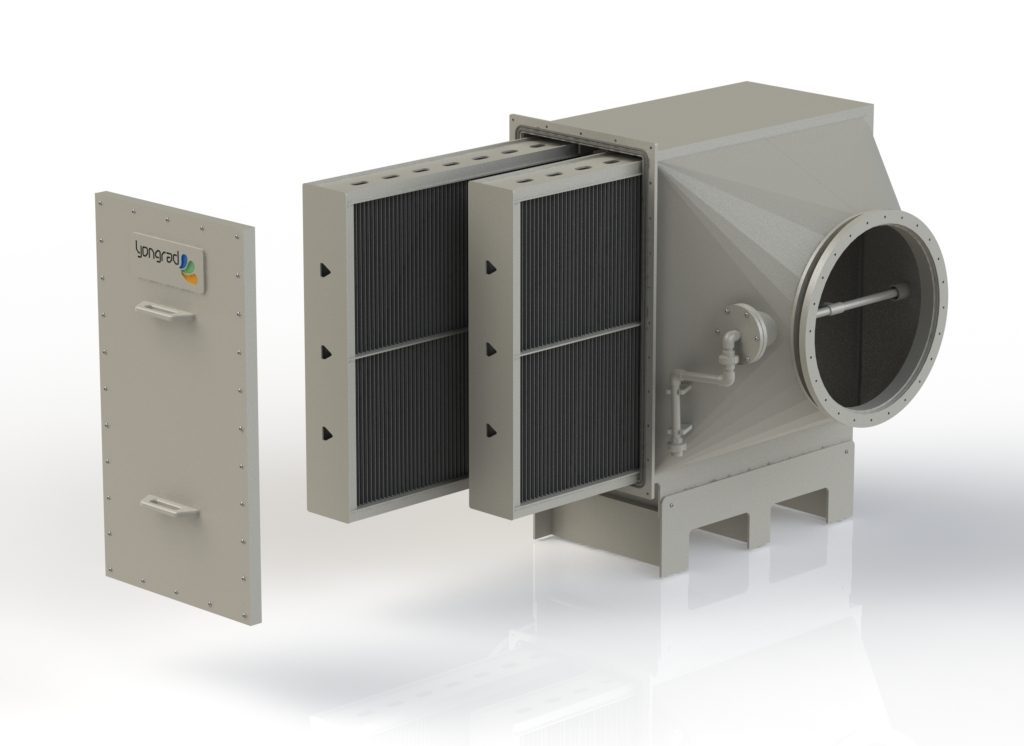
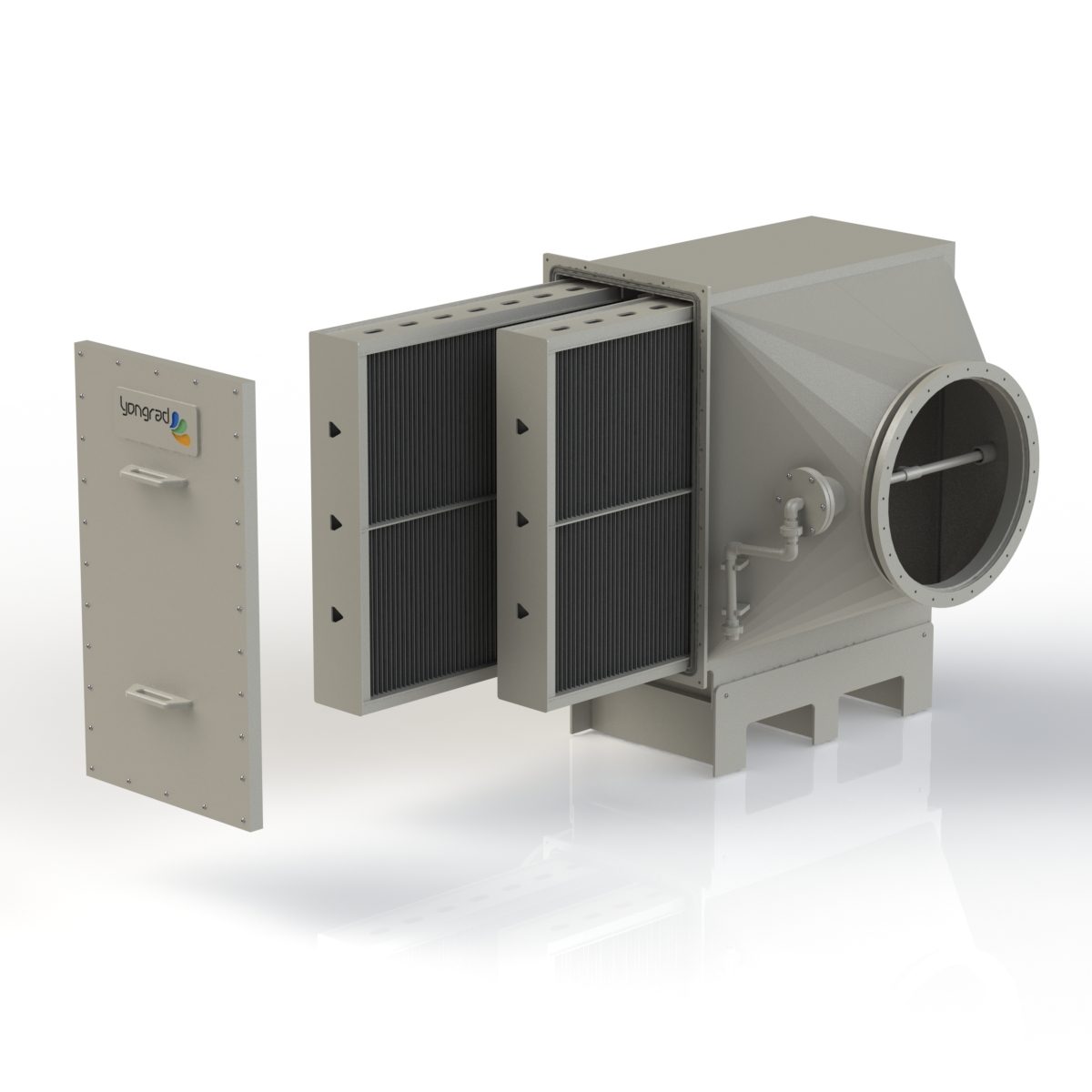
- Aerodynamic polymer vanes (chevron): Fully corrosion-resistant PP or PVC guide vanes that minimise the pressure drop (ΔP) while maximising the impact surface for the droplets.
- Integrated drainage channels: Drainage paths that return the captured liquid safely to the collection sump or the process without it being re-entrained in the air stream.
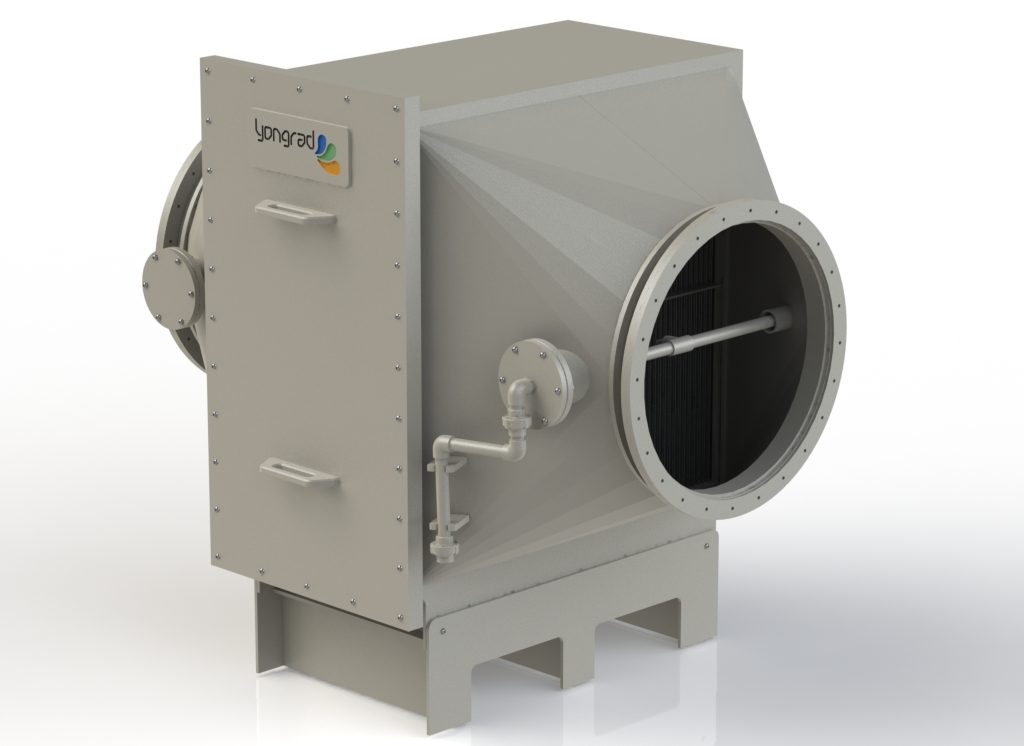
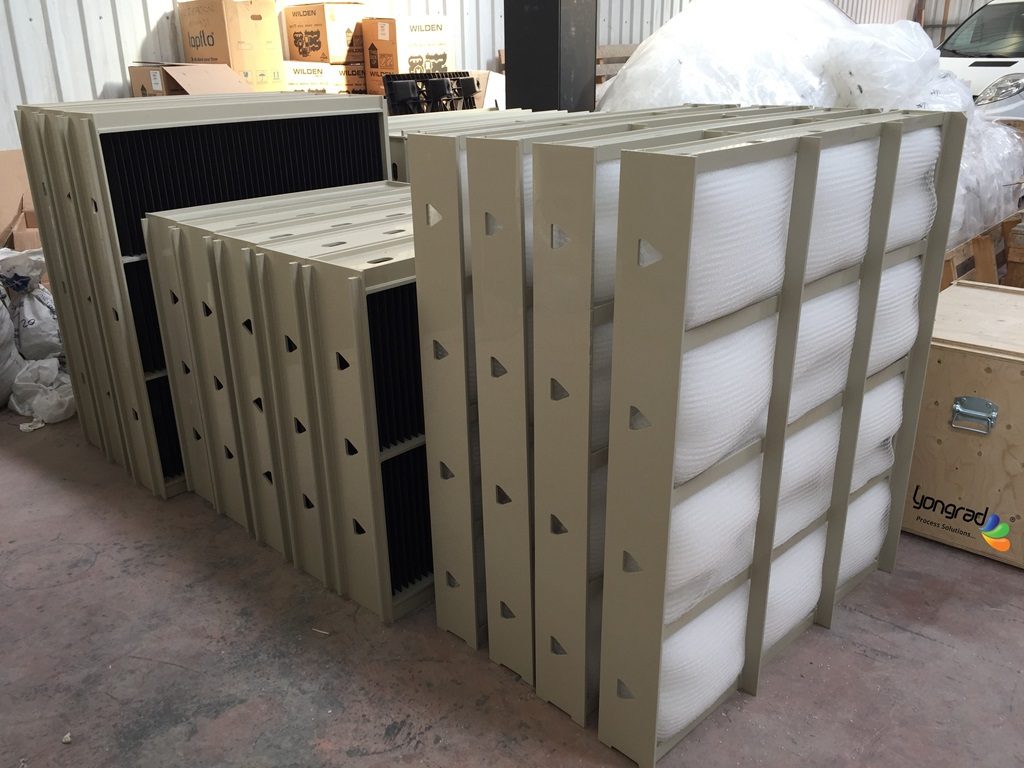
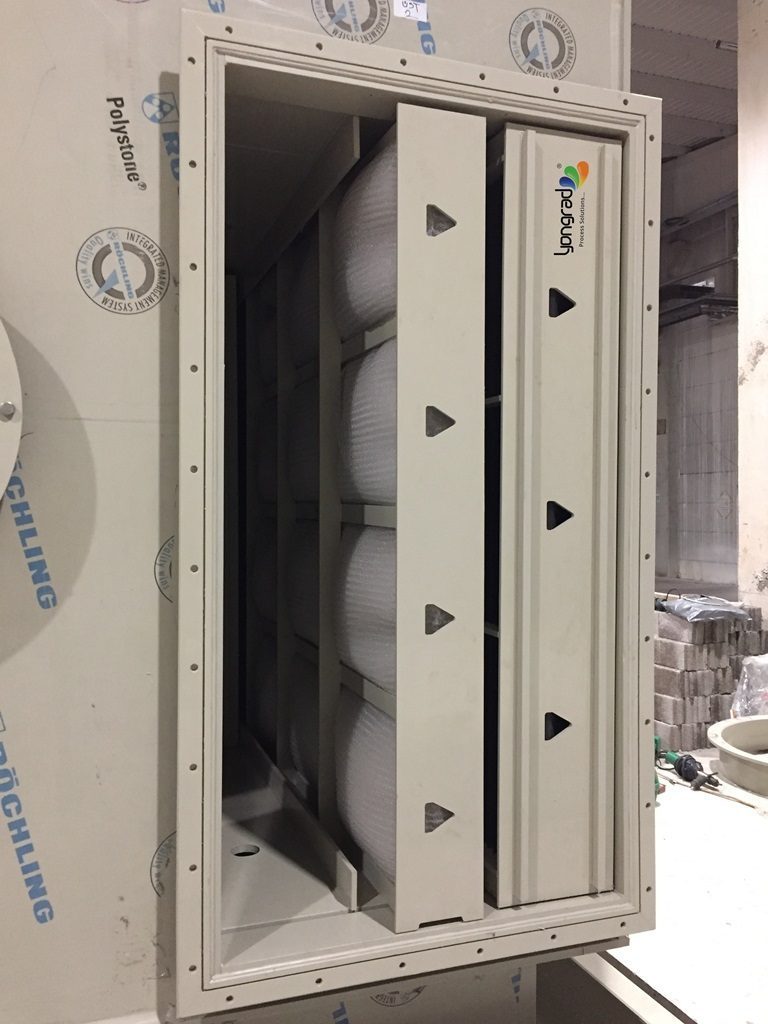
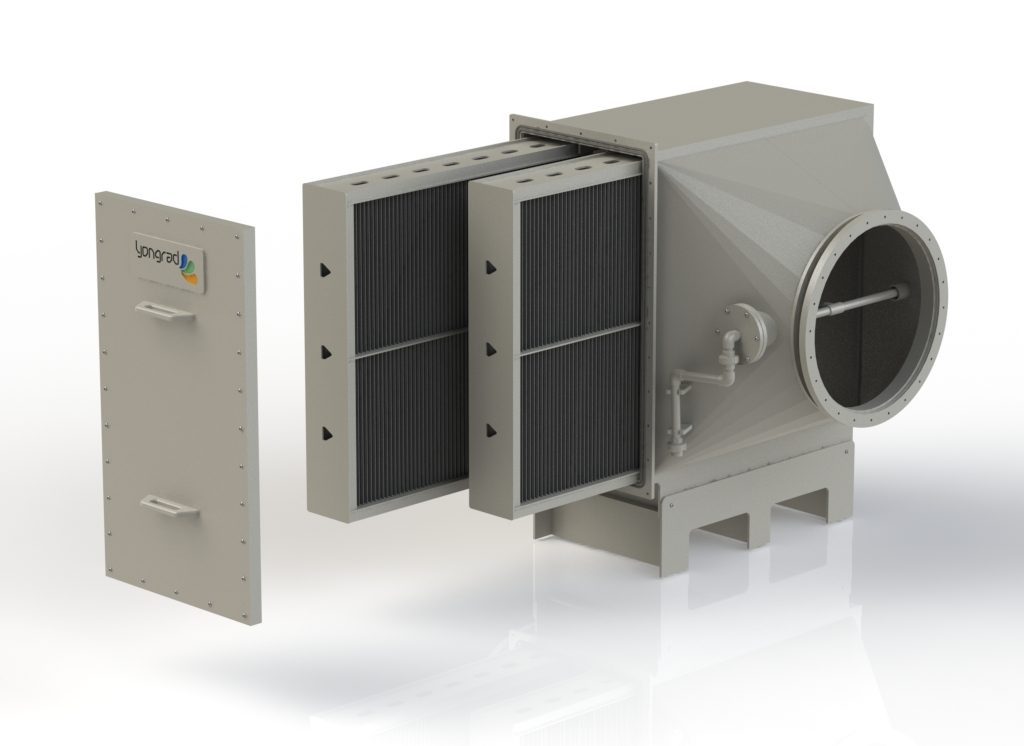
- Modular cassette construction: Filter blocks that slide out and back in one movement for cleaning or maintenance, with no work on the housing itself.
- Global Industry Applications
-
- Scrubber outlets: Capturing the acid or alkali droplets in the air leaving the wash tower before they reach the fan motor or the atmosphere.
- Surface finishing and plating plants: Recovering the bath liquid carried away by the air in the local push-pull extraction over pickling, zinc and nickel tanks.
- Cooling towers: Minimising drift loss at the discharge of water cooling towers and stopping droplets spreading into the surroundings.
A droplet eliminator is the critical point where concentrated acids and aggressive liquids carried in the air strike the surface directly and collect there. Even 316L stainless steel succumbs to that constant acidic wetness, whereas PP is inert to acids at molecular level: it neither rots nor deforms.
No. The chevron vanes are designed at specific angles — two- or three-pass — to give an aerodynamic passage. In normal operation the pressure drop is a very low 150 to 250 Pa, which barely loads the fan.
For the best capture, the face velocity between the vanes should generally be 3 to 6 m/s. Too slow and the droplets lack the inertia to strike the vane; too fast and the captured droplets are re-entrained and escape. Our engineers size the cross-section to that range for your flow rate.
In processes carrying only clean droplets, no. Where the air also holds sticky vapours or solid particles, periodic wash nozzles are fitted so the system cleans itself.
Mist Eliminators Knitted mesh pads for micro-aerosols
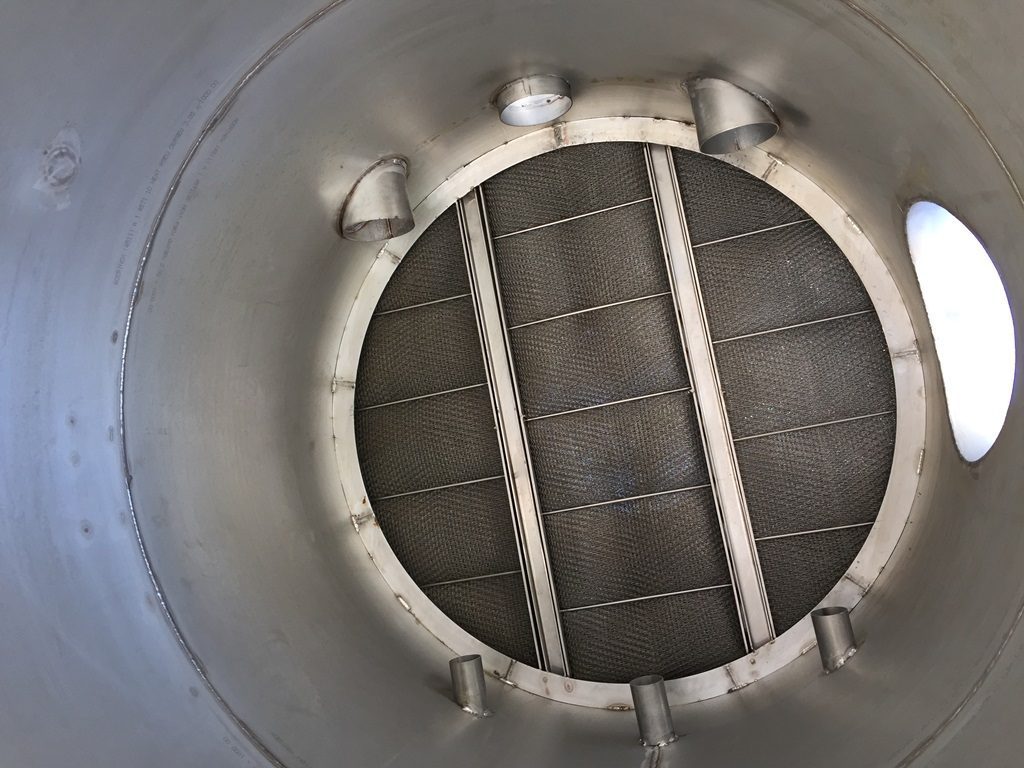
Advanced filtration systems for the very fine aerosols a droplet eliminator cannot catch, generally between 3 and 20 microns. For particles of that size, where simple impaction is no longer enough, multi-layer knitted polymer mesh pads or micro-fibre pads relying on Brownian motion are used. As the gas passes through the dense weave, the finest mist particles adhere to the filaments, coalesce, grow heavier and drain away.
- System Components
-
- Multi-layer polymer mesh pad: High-density capture pads knitted from PP, PVDF or special thermoplastic filaments, fully resistant to acid vapour and high temperature.
- Structural support grids: Corrosion-resistant heavy plastic cages above and below that stop air pressure deforming the pad.
- Diffuser plates: Aerodynamic inlet chambers that stop the incoming air loading one spot and distribute it evenly across the pad.
- Global Industry Applications
-
- Hard chrome plating lines: Capturing at 99.9 % efficiency the extremely harmful, very fine chromic acid aerosol rising from the baths.
- Sulphuric acid manufacture and storage: Stopping the ultra-fine acid mist from tank vents and reactor exhausts that ordinary systems let through.
- Machining and CNC work: Containing locally the dense oil mist that cutting fluids create at high spindle speeds, before it spreads through the workshop.
Chevron eliminators capture the larger droplets (>20 microns) and rarely block, even in dirty, particle-laden air. Mesh pads have a dense knitted structure to catch very fine aerosols (<20 microns); their efficiency is far higher, but where dust or sticky particles are present they can block quickly.
Chromic acid, being strongly oxidising, can fatigue standard polypropylene over time. In such specific and aggressive mist environments we secure the system with PVDF (polyvinylidene fluoride) mesh pads, whose chemical resistance and thermal stability are of the highest order.
Their dense weave gives a somewhat higher resistance than a droplet eliminator, generally 250 to 500 Pa. That resistance is balanced exactly by fitting a thermoplastic fan with the right pressure curve.
That depends on the chemical load and the running hours. But our corrosion-free thermoplastic pads keep their shape and efficiency for years, provided they are not torn mechanically or heavily fouled with particles.
Wet Baffle Separators Systems that cannot block
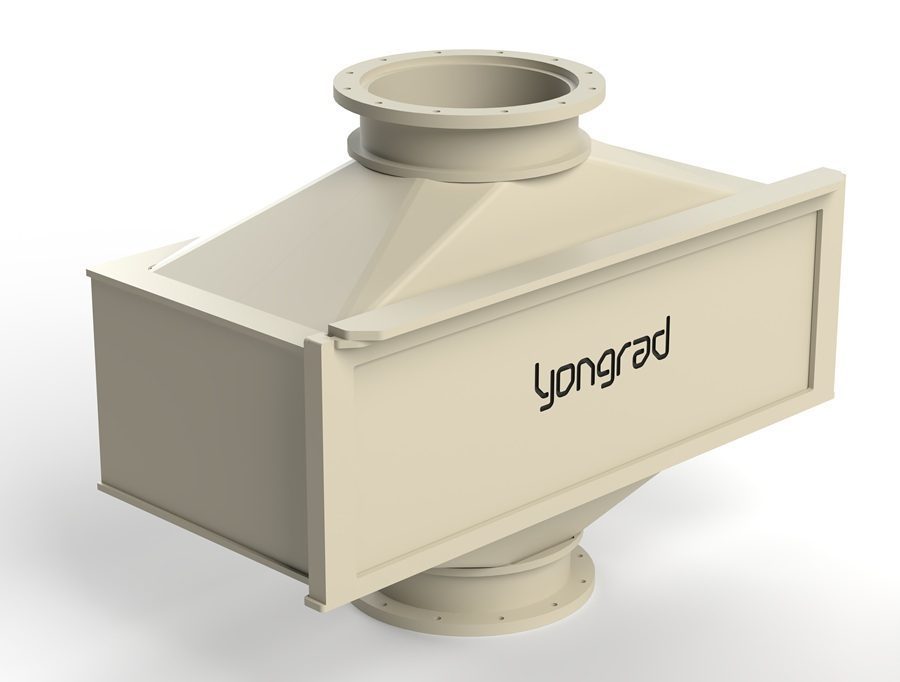
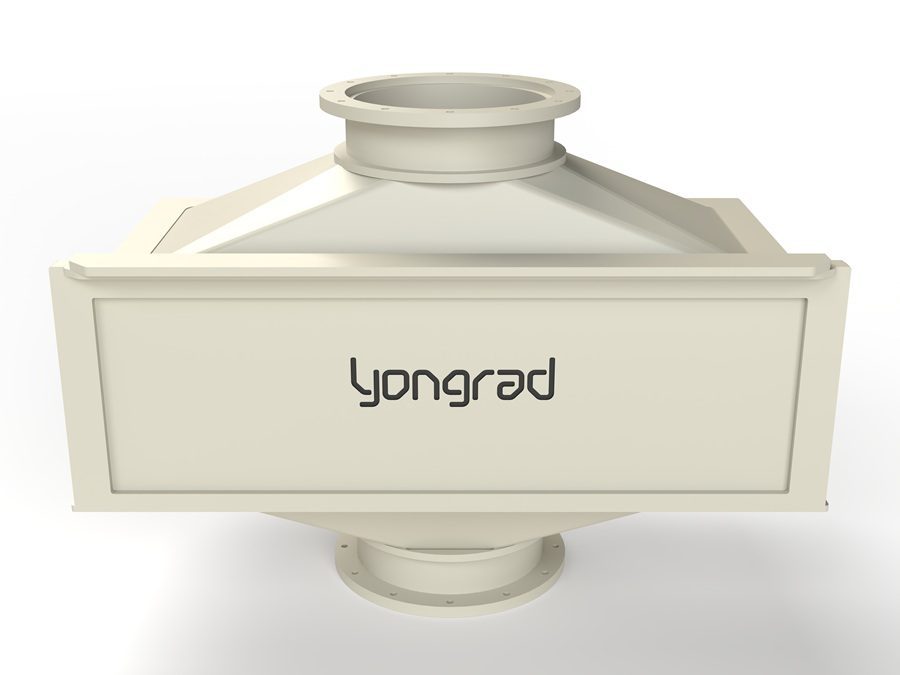
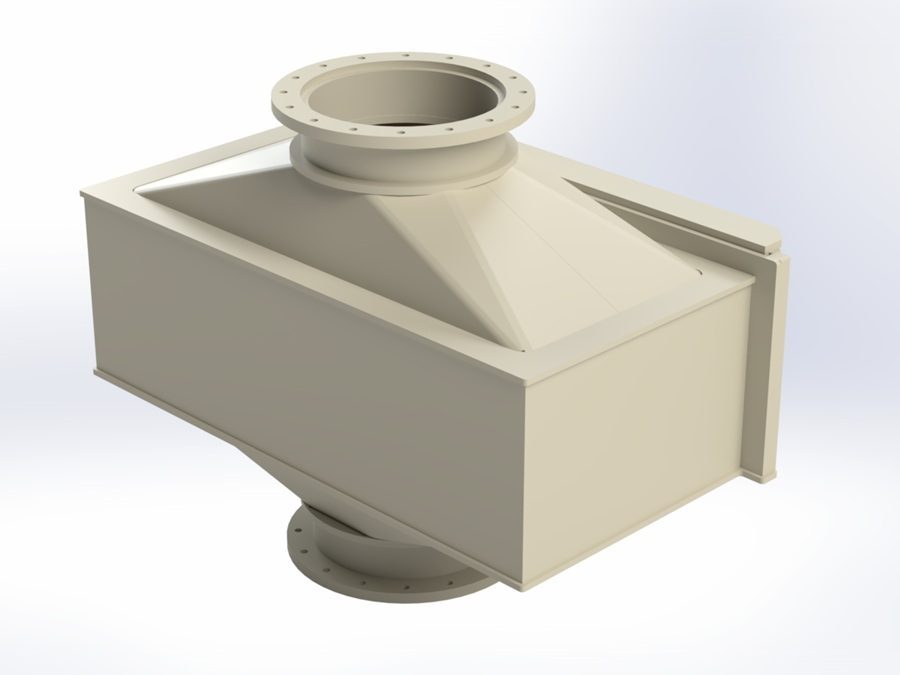
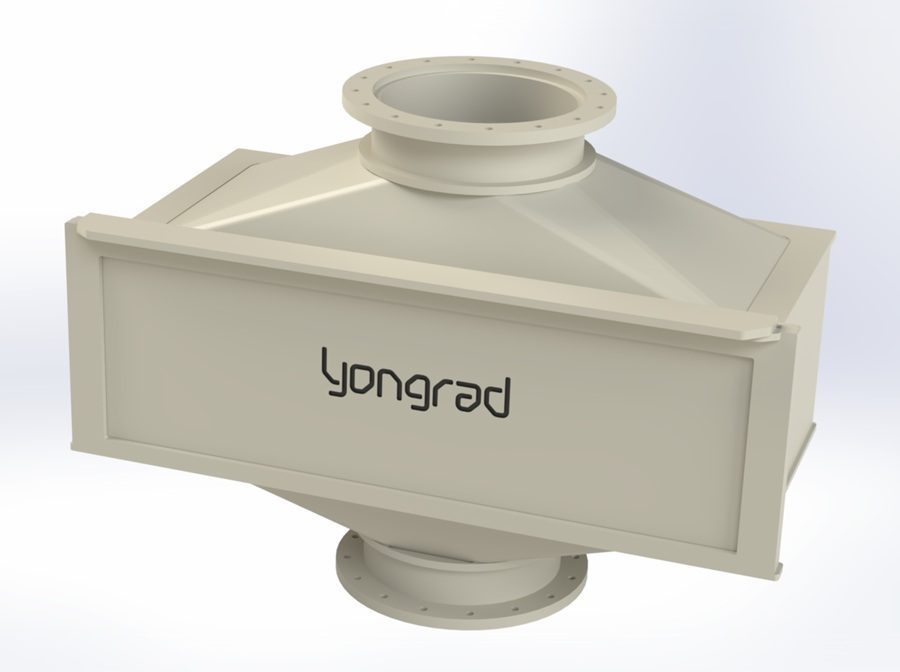
Where the gas stream carries not only droplets but sticky solids, chemicals that tend to form sludge or heavy dust, a conventional eliminator blocks within a short time. In a wet baffle separator, purpose-designed impact plates are wetted continuously or periodically by a spray bar. When liquid or solid particles strike the wet plates, the water running down washes them immediately into the sump below. The capture surfaces therefore stay permanently clean and cannot block.
- System Components
-
- Wide-angle impact plates: Heavy-section PP or PE guides at wide angles, easy to wash and shaped so sticky particles cannot lodge.
- Integrated spray bar: A non-clogging spray manifold positioned to maintain a continuous water curtain over the plate surfaces.
- Sloped effluent sump: Drainage that carries the sludge-laden or chemically concentrated washings away quickly, without letting them accumulate in the unit.
- Global Industry Applications
-
- Paint booth exhaust systems: Catching and washing away the sticky overspray from wet painting on the wetted surfaces, before it reaches the fans.
- Phosphating and pre-treatment lines: Uninterrupted extraction on hot lines carrying both vapour and crystallising salt particles.
- Drying ovens and foundries: Pre-treating heavily loaded process exhaust in which dust and oil vapour occur together.
No. The system recirculates the water — or chemical solution — from the sump back to the nozzles with a pump. Consumption amounts only to evaporation losses and what is blown down because of contamination. The wash runs as a fully closed loop.
Because the recirculated liquid may carry particles, standard fine-orifice nozzles are not used. Instead we fit industrial non-clogging spiral nozzles with a wide orifice and good atomisation.
It is far more compact than a conventional scrubber tower. Fitted as a flanged in-line module into existing horizontal or vertical ductwork, it leaves the plant layout undisturbed.
Because the system washes itself, no daily or weekly cleaning stops are needed. Only at long intervals are the plates checked mechanically, safely, through the external inspection and service doors.
Compact Cyclone Separators Separation by centrifugal force
Compact structural units, rated for high flow, that separate very heavy liquid loads or coarse solids from the air or gas stream by centrifugal force. The dirty gas or vapour enters the cylindrical body tangentially at high speed and forms a vortex inside. Heavy droplets and particles are thrown against the outer wall, lose their velocity and drain into the conical section below, while the cleaned air leaves upwards through the centre.

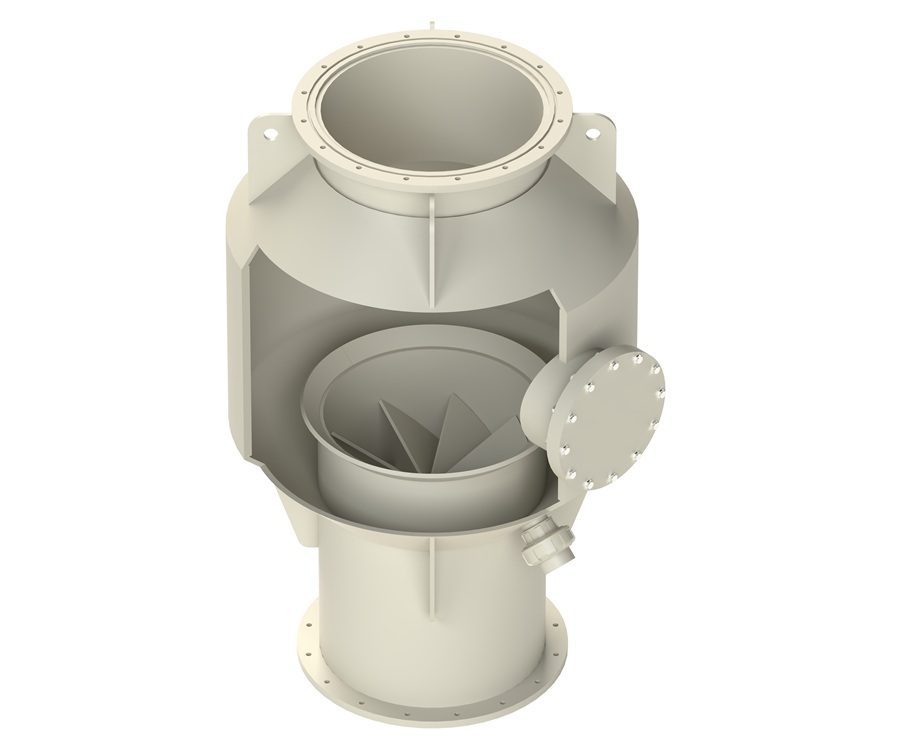
- System Components
-
- Tangential inlet scroll: A pressure-optimised polymer inlet that sets the incoming air rotating aerodynamically.
- Conical separation body: A tapering base that accelerates the smooth downward drainage of the liquid and solid phase, without it being caught in turbulence.
- Discharge module (airlock/valve): The key point at which the collected liquid or solid is discharged safely to the process or to waste, without drawing false air back into the system.
- Global Industry Applications
-
- Pre-separator systems: Shielding units installed ahead of the sensitive droplet eliminators or scrubbers on lines with very heavy liquid carry-over, taking around 80 % of the load off the main system.
- High-speed CNC and machining centres: Rapid simultaneous separation of coarse droplets and metal dust from the air where high-pressure coolant is heavily entrained.
- Boiler and steam exhausts: Draining the heavy condensate from industrial steam lines.
A cyclone does not filter finely — it works by brute force. If your process carries a substantial amount of liquid or sticky, abrasive sludge along with the air, a conventional vane eliminator would drown or wear through immediately. The cyclone is the first line of defence that takes that heavy load in its stride.
Absolutely. For the cyclone to generate centrifugal force the air must enter the body at a certain velocity. With an undersized fan, or if the flow falls away, no vortex forms and separation efficiency drops sharply.
Particles striking the wall at high speed can cause mechanical erosion. For processes with a heavy solids load we therefore build the cyclone not in standard PP but in highly wear-resistant HDPE or UHMWPE, with extra wall thickness.
Because the cyclone is the first equipment to meet the heavy liquid or solid load, it usually sits close to the process outlet and ahead of the main ventilation and filtration. Its compact form lets it be fitted in-line into your existing layout.