



Wastewater Treatment Tanks.
Process reactors that carry out coagulation, flocculation and settling at maximum efficiency.
The core of physical, chemical and biological treatment: the process reactors.
These process reactors form the core of physical, chemical and biological treatment, and are optimised to carry out coagulation, flocculation and settling at maximum efficiency.
Lamella Clarifiers Compact clarification reactors
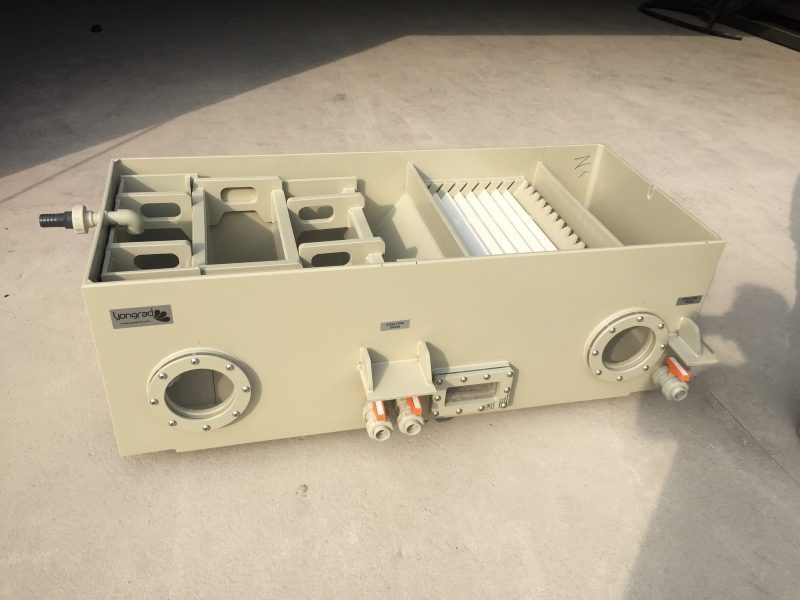
Compact rectangular above-ground reactors in high-density PP/HDPE that deliver the same surface loading and clarification capacity as a classic circular basin in a tenth of the space.

- System Architecture
-
- Inlet diffusers designed on fluid dynamics for even distribution, and V-notch weir systems.
- PP lamella modules in honeycomb or tube form, set at 60°.
- A flanged rectangular hopper base that helps the heavy sludge thicken and draw off.
- Industry Applications
-
- Turbidity removal in municipal drinking water treatment plants.
- Closed-loop water recovery in mining, marble and ceramics plants.
No. The modules rest on a dedicated support frame of steel sections, braced off the tank wall, which guarantees their structural capacity.
They collect the water off the surface at an even rate, laminar and without waves, and without disturbing the sludge below, which guarantees complete clarity.
Density sensors in the hopper, together with pneumatic diaphragm or rotary pumps, draw the sludge off automatically on a timer once it reaches a set solids content.
Sedimentation Tanks Quiescent basins working on gravity alone
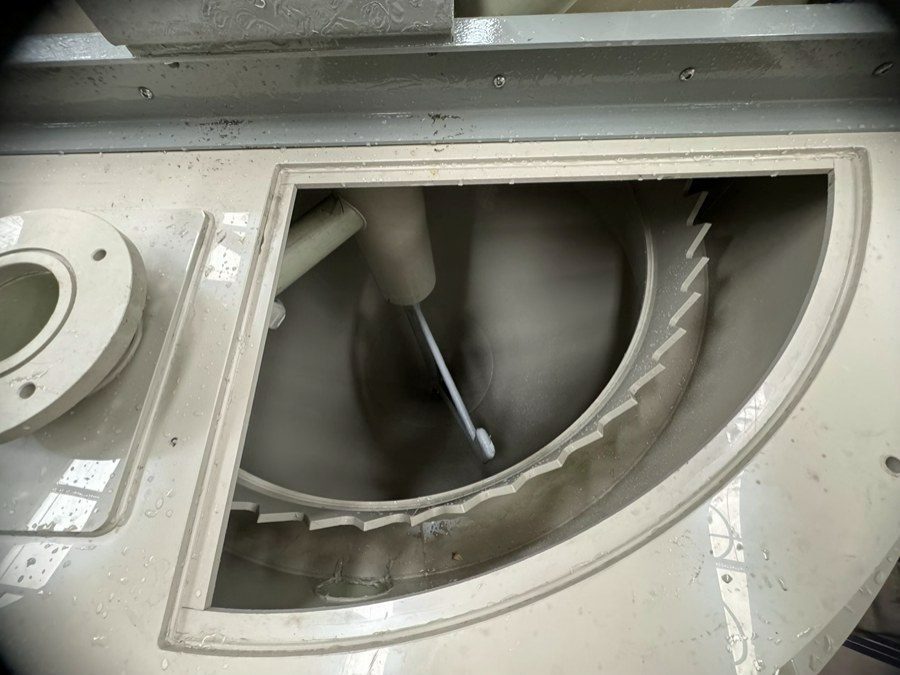
Quiescent basins in which the flow velocity is brought hydrodynamically close to zero so that suspended solids settle to the floor under gravity alone, with no plates or lamellae.

- System Architecture
-
- A monolithic thermoplastic body, circular or horizontal-flow, with baffle walls against turbulence.
- Surface skimmers that collect the light scum and oil.
- Corrosion-resistant rotating bridge scrapers in PP-clad steel that gather the floor sludge to the centre.
- Industry Applications
-
- Primary settling of coarse solids in paper and pulp effluent.
- Recovering the scrubber water from steel plants and foundries.
Diffuser baffles at the inlet spread the water evenly through the basin, so it cannot travel straight to the outlet before its settling time is complete.
Concrete erodes, cracks under acid or alkali shock and starts to weep through its micro-pores. Our thermoplastic tanks are fully resistant to those shocks, need no construction time, and their smooth surface stops sludge adhering.
The scraper drives have mechanical torque limiters and electronic current protection relays. Under an excessive sludge load the system protects the motor and sends a fault signal to the SCADA.
Flocculation Reactors Reaction units for coagulant and flocculant
Reaction units in which coagulants and flocculants are mixed into the effluent evenly down to micron level, the electrokinetic charges are neutralised and heavy, readily settling flocs are formed.


- System Architecture
-
- A cylindrical or multi-chamber polymer reactor geometry that eliminates hydraulic dead zones.
- Variable-frequency, slow-running paddle agitators that do not break the flocs.
- A PP/PVDF internal surface with absolute resistance to corrosion and to acid or caustic dosing shocks.
- Industry Applications
-
- Decolorisation in textile dyehouses.
- Heavy metal precipitation in plating and metal finishing effluent.
The chemical first needs a few seconds of high-turbulence mixing to disperse evenly and start the reaction. After that, very gentle agitation is needed so the particles can collide and grow into flocs without being torn apart.
Vertical baffle plates on the inner wall of the cylindrical tank interrupt the flow and convert the centrifugal force of the blades into turbulence, so the liquid mixes axially instead of rotating as a block.
Even where the shaft is made of stainless steel it is sheathed in a one-piece PP cover. Contact between the liquid and the metal is eliminated entirely.
DAF Units Dissolved air flotation — advanced flotation reactors
Advanced flotation reactors in which very light solids, oils and emulsions — which will not settle but tend to float — are carried to the surface by air dissolved in the water under pressure and released as micro-bubbles of 30 to 50 microns.

- System Architecture
-
- A high-pressure air saturation vessel at 4 to 6 bar, and manifolds of dedicated micro-bubble nozzles.
- Chain or linear surface scraper flights that collect the float layer.
- A fully enclosed PP or HDPE body resistant to acid and chlorine attack throughout.
- Industry Applications
-
- Removing heavy organic fat and COD loads in abattoirs and meat and dairy processing.
- Bringing industrial effluent to discharge standards such as DIN 1999 in infrastructure and petrochemical facilities, integrated with coagulation and flocculation.
Bubbles that are too large rise quickly without taking the particle with them; too small and they generate too little lift. The saturation system is calibrated to produce even white water at the ideal 30 to 50 microns, which clings to the particles like a magnet.
Although the aim is flotation, the heavier particles will still settle. The DAF floor is therefore built as a hopper, and the heavy sludge is removed periodically by a bottom auger or pneumatic valves.
Between 10 % and 30 % of the clarified water leaving the DAF is drawn off, saturated with air in the pressure vessel and returned to the system. The PLC sets that ratio automatically through modulating valves, according to the suspended solids load.