



Electrochemical Units.
Closed-cell reactors in which Faraday's laws are applied with absolute precision and the current density is evenly distributed.
Cell reactors that redefine the tribological and electrical character of a material at atomic level.
Electrochemical surface modification requires closed-cell reactors in which Faraday's laws are applied with absolute precision. With the current density evenly distributed, these systems redefine the tribological and electrical character of the material at atomic level.
Titanium Colour Anodising Units Precise anodising lines governed by voltage
These precise anodising lines manipulate the refractive index of light at the titanium surface, growing biocompatible oxide layers of controlled appearance that give advanced engineering materials their character. On biomedical and defence components they build the oxide layer to nanometre accuracy and perfect the voltage-controlled colouring.


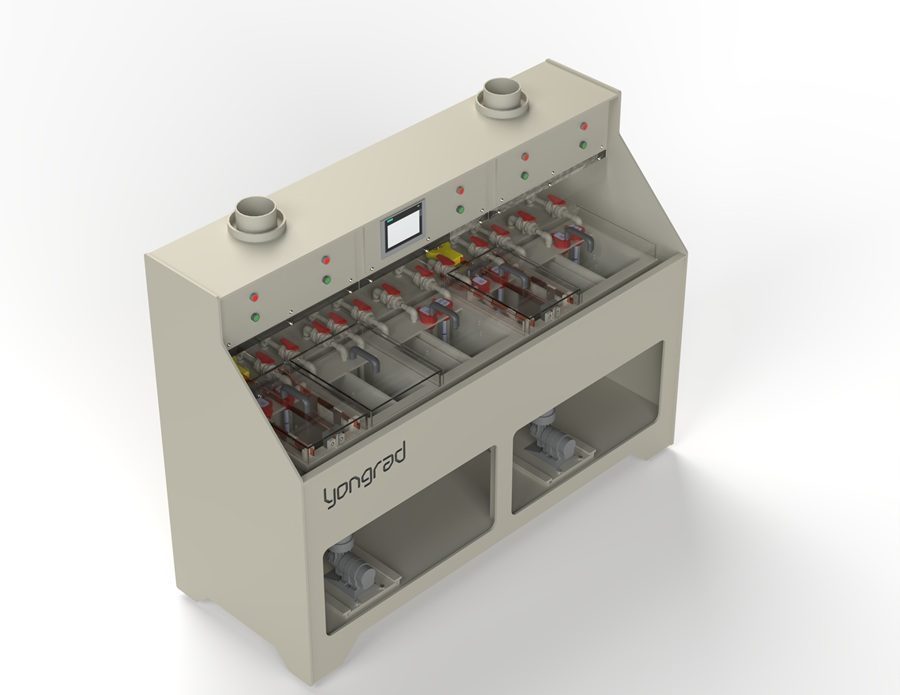
- Reactor Architecture
- Fully corrosion-resistant monolithic polymer baths and thermal stabilisation by heat exchanger.
- Electrodynamic Control
- High-precision low-ripple DC rectifiers and V-block busbar contacts for loss-free transmission.
- Critical Applications
- Colour-coding the sizes of orthopaedic and dental implants, and passivating lightweight titanium fasteners for the defence industry.
Conformal cathodes modelled to the geometry of the part are integrated, together with thief electrodes that keep the field lines from crowding at points and edges.
The colour depends entirely on the thickness of the oxide layer, and that thickness on the applied voltage, generally between 10 and 110 V. Our rectifiers, with a ripple below 1 %, leave no visible colour deviation.
The system holds electrolyte concentration and temperature within a narrow band using integrated heating and cooling exchangers, and so keeps the reaction kinetics steady.
ENIG Plating Units Electroless nickel immersion gold reactors
Designed for the electroless nickel immersion gold process, these reactors prevent oxidation on defence and semiconductor PCBs, eliminate signal loss and give faultless solderability. They deposit nickel as a corrosion barrier over the copper traces and then an unreactive gold layer, evenly and by purely chemical means.


- Reactor Architecture
- Heat-resistant inner tanks in pure PTFE/PFA with reduced surface energy, preventing plate-out.
- Process Control
- Filtration pumps that keep the bath turning over, automatic pH and nickel concentration analysers, and dosing units accurate to the microgram.
- Critical Applications
- Multi-layer HDI (high density interconnect) PCB manufacture for aerospace avionics, and high-frequency RF radar modules.
Black pad occurs when an aggressive gold bath corrodes the nickel layer. The system monitors the pH and temperature of the gold bath and the phosphorus content of the nickel continuously, and manages the dosing to microgram accuracy.
Bath lids and condensation panels return the evaporated, valuable solution to the bath. At the same time in-line level sensors add DI water to stop the concentration rising.
Conventional plastics eventually cause plate-out, where the tank wall itself becomes plated. Our smooth fluoropolymer tanks lower the surface energy and prevent that unwanted deposition.
Electropolishing Units Ultra-smooth surfaces through anodic dissolution
Reversing the micro-roughness of the metal surface by anodic dissolution, these units create ultra-smooth, sterile surfaces that mechanical polishing could never reach and to which no particle can adhere. On stainless steel, titanium and nitinol they reduce the surface roughness (Ra) to micro and nano levels and deliver complete passivation.


- Electrodynamic Control
- High-amperage DC rectifiers and conformal lead or copper cathodes able to withstand the heavily acidic bath.
- Thermal and Gas Management
- Powerful chiller-backed acid heating and cooling, with a scrubber connected directly to the acid vapour.
- Critical Applications
- Polishing the internal surfaces of cardiovascular stents, surgical instruments and the stainless ultra-pure water (UPW) pipework of semiconductor plants.
Internal cathodes matched to the tube geometry are centred inside it, and the electrolyte is pumped through at high turbulence via dedicated nozzles, so hydrogen cannot accumulate.
Vigorous mechanical agitation and an optimised electrolyte viscosity sweep the bubbles away before they can cling to the surface, so the risk of pitting is removed entirely.
Chilled water circulating through purpose-designed titanium or Teflon-clad exchanger coils holds the process temperature within ±1 °C and keeps the removal rate stable.
Electrowinning Units Cells for precious metal recovery
Separating heavy and precious metal ions from solution at the cathode at molecular level, these electrometallurgical cells serve waste management and circular economy goals at the highest purity. They recover the metals from spent plating baths and effluent as sheet.
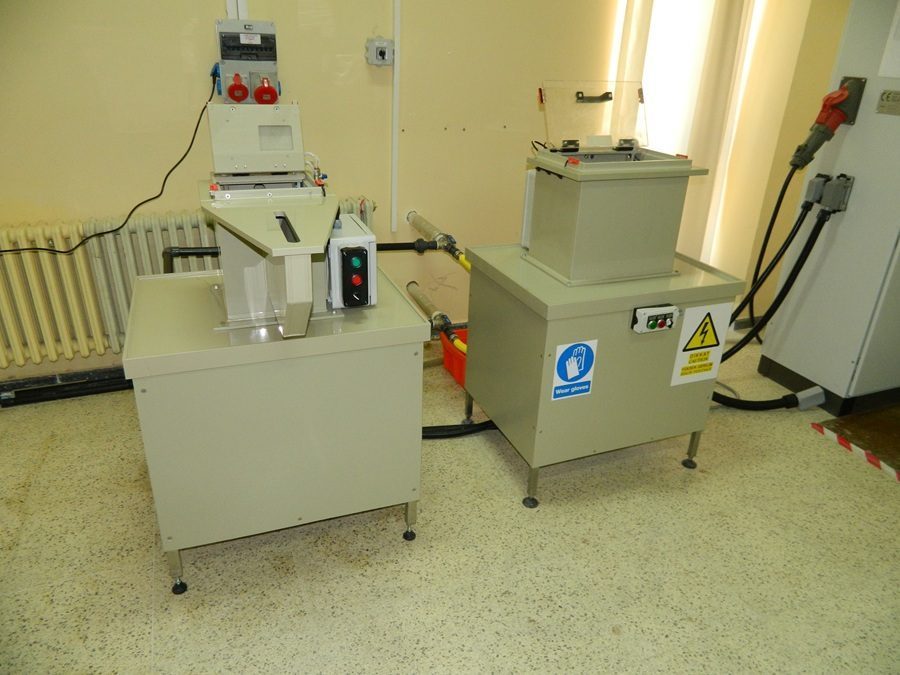
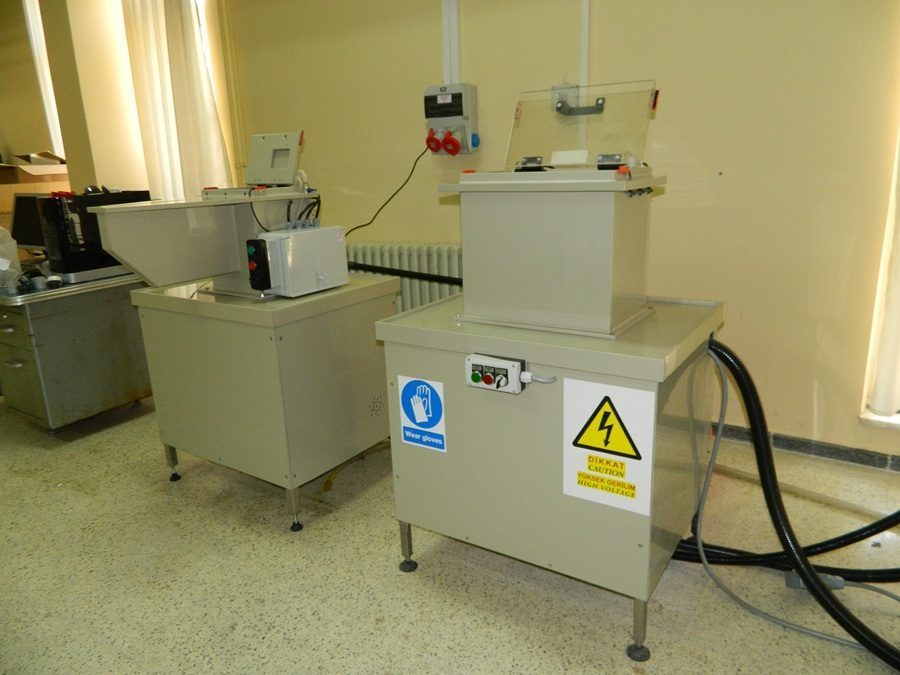
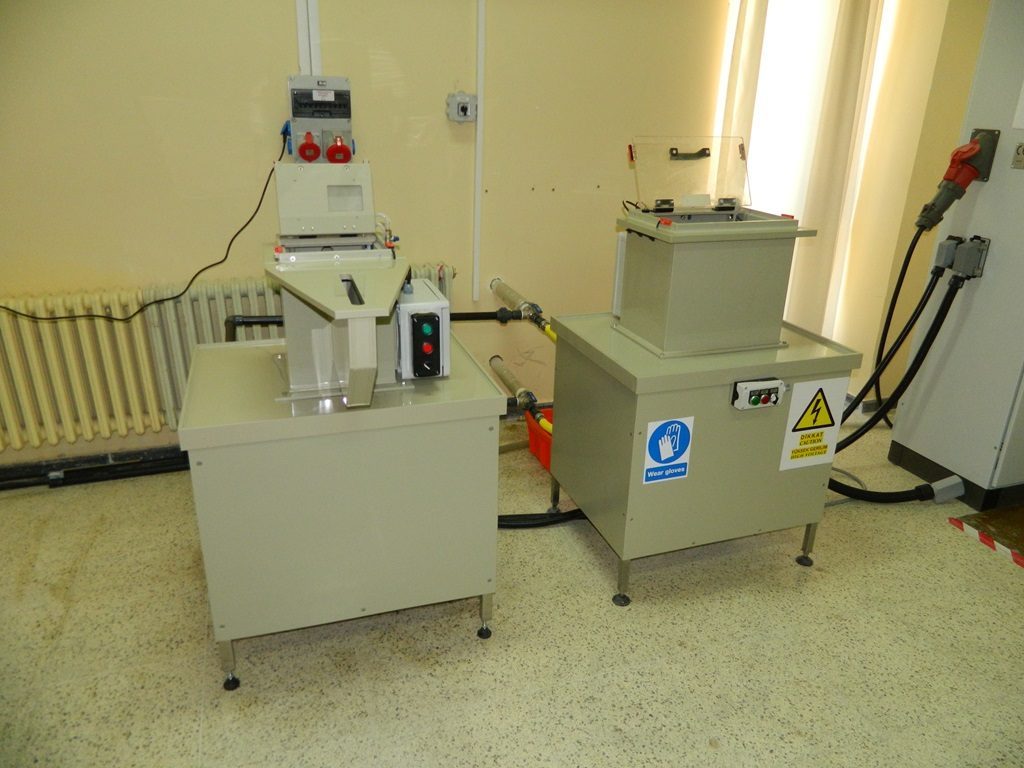
- Reactor Architecture
- Leak-tight monolithic HDPE tanks with absolute resistance to aggressive acids and to fatigue.
- Electrode Systems
- Titanium MMO anode meshes that raise energy efficiency, and stainless steel cathode stripping plates.
- Critical Applications
- Recovering valuable nickel and copper from defence-industry effluent, and pure gold from the cyanide gold baths of semiconductor PCB lines on a zero-discharge principle.
Conventional, lower-density materials fatigue under strong acid, develop micro-cracks and can contaminate the process with particles. High-density monolithic HDPE, by contrast, shows enormous mechanical resistance to aggressive chemistry, stays completely inert and guarantees 99.9 % purity in the recovered metal.
The MMO coating lowers the oxygen and chlorine overpotential at the anode surface, which raises energy efficiency, and stops anodic dissolution in the acid, extending anode life by years.
Machined V-shaped polymer electrode guides hold the gap between anode and cathode plates to micron accuracy and make physical contact impossible.