



Industrial Wet Bench Units.
Reactors for surface preparation and wet etching in which particle and ionic contamination is held at ppt levels.
The principal reactors of processes demanding cleanliness at parts per trillion.
Wet bench systems are the principal reactors of processes in which particle and ionic contamination must be held at parts per trillion. Through the surface preparation and wet etching steps they provide full containment, hydrodynamic stability and process uniformity.
Manual Wet Bench Flexible stations for research and small-batch work
Designed for research laboratories and specialised small-batch lines, these stations are engineered barriers that raise operator safety aerodynamically to its highest level in flexible chemical work where human judgement is needed. In low-volume specialist processes they handle precise chemical cleaning, manual immersion and surface preparation faultlessly.


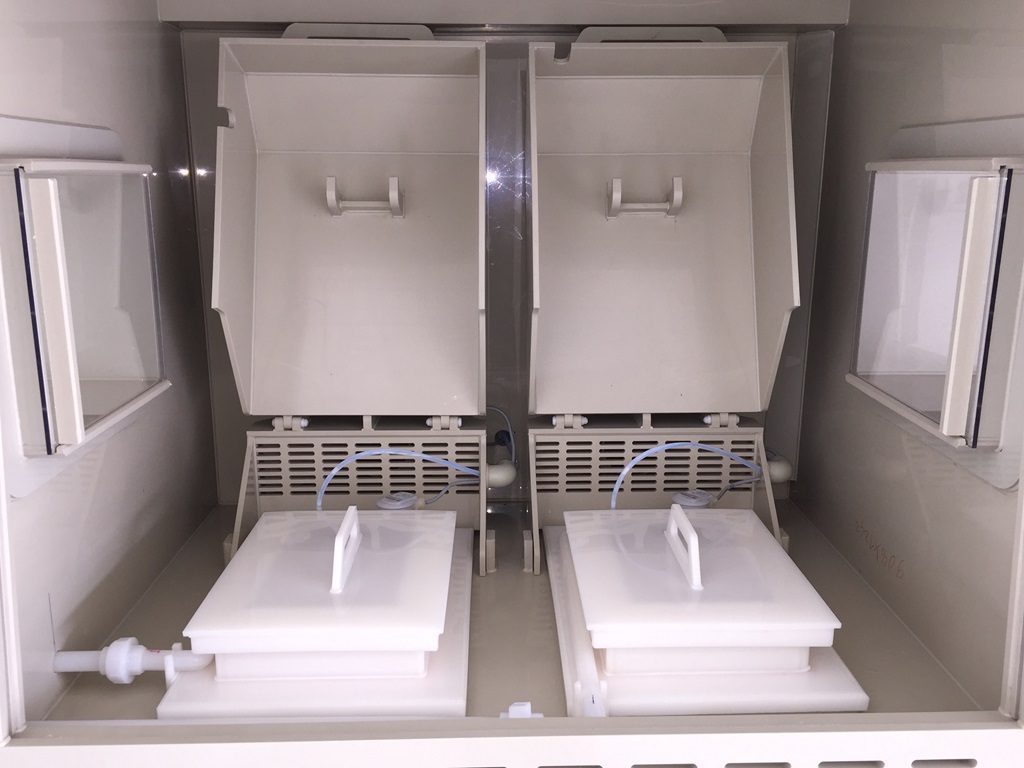
- System Architecture
- A monolithic body in FM4910-approved flame-retardant polypropylene (FRPP), with seamless joints made by infrared butt welding.
- Fluid and Exhaust Control
- Manual PTFE diaphragm valves and local down-draft extraction ducts that isolate the operator's breathing zone.
- Critical Applications
- RCA wafer cleaning trials in university nanotechnology laboratories, and manual passivation of titanium implants in medical prototype work.
Localised down-draft extraction channels around the bath and transparent polycarbonate splash guards isolate the operator's breathing zone completely from the chemical vapour.
Each bath cell is physically separated by tall PP barriers, and an independent drain is run for every chemical so the liquids can never mix.
The system has hardware interlocks that cut power to the quartz or fluoropolymer-clad heaters automatically as soon as the level sensor sees the liquid fall below its set point.
Modular Wet Bench Scalable platforms with plug-and-play flexibility
Adapting instantly to changing recipes and offering plug-and-play flexibility when capacity grows, thanks to their cellular construction, these are process platforms built for the future. On scalable production lines they allow different bath configurations to be changed over quickly.


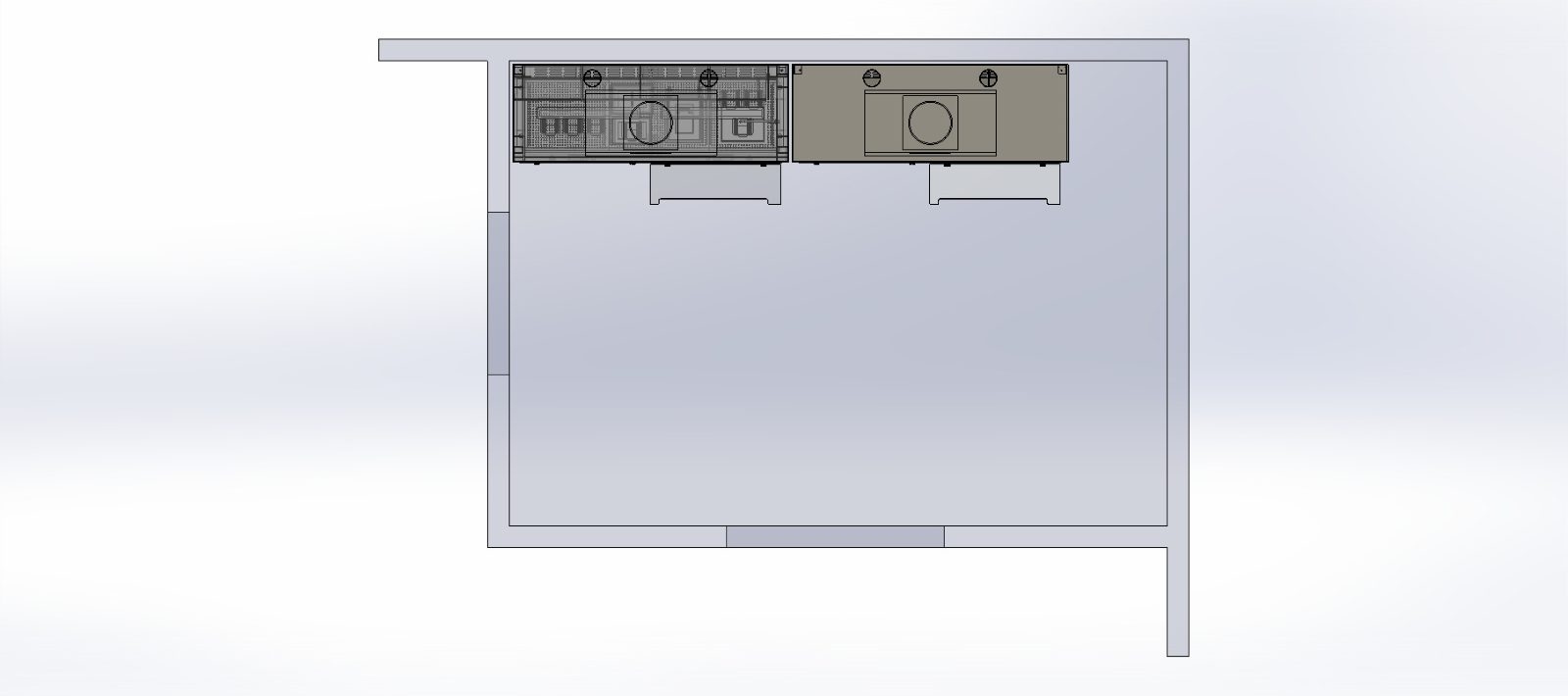
- System Architecture
- Modular exchangeable bath cassettes that integrate quickly into the line, with quick-disconnect PFA tubing throughout.
- Automation Network
- Independent closed-loop I/O modules communicating in real time with the central HMI.
- Critical Applications
- Batch cleaning of RF modules of varying size in the aerospace industry, and running different etch recipes from a single line in semiconductor test facilities.
Machined tongue-and-groove polymer joints and two-layer EPDM/Viton gaskets block the passage of chemical vapour and liquid down to the micron.
The fluid system is fitted with closed-loop pressure regulators that compensate for pressure changes automatically, so adding a new rinse module leaves the existing flows untouched.
Yes — the main PLC treats each module as a separate process node. Recipes can be programmed independently for every cell, with their own temperature, time and dosing parameters.
Semi-Automatic Wet Bench PLC-controlled reactors built for repeatability
In these productivity-focused reactors the machine takes the critical parameters — temperature, flow, concentration — into its own hands, and the operator only loads and unloads the cassettes. The hydrodynamic and thermodynamic cycles run automatically, raising repeatability and consistency to their highest level.
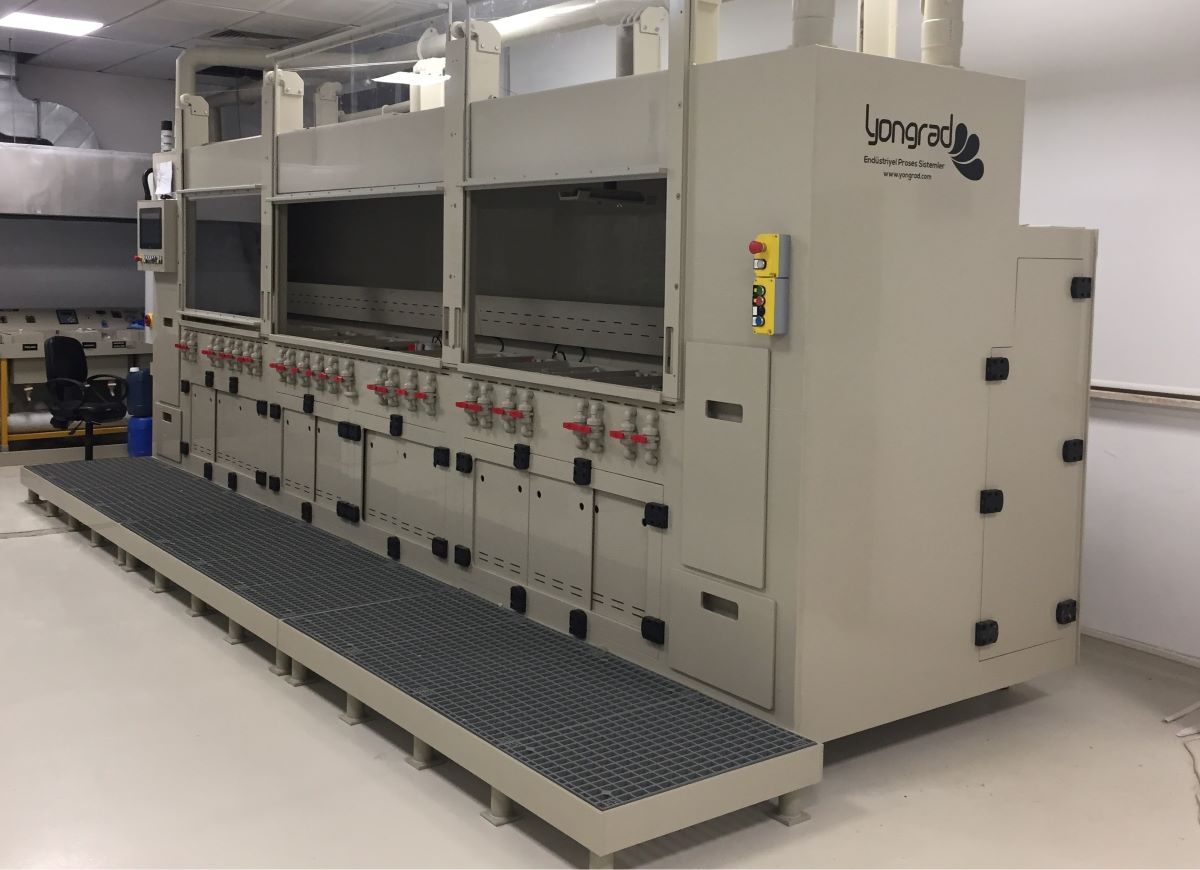

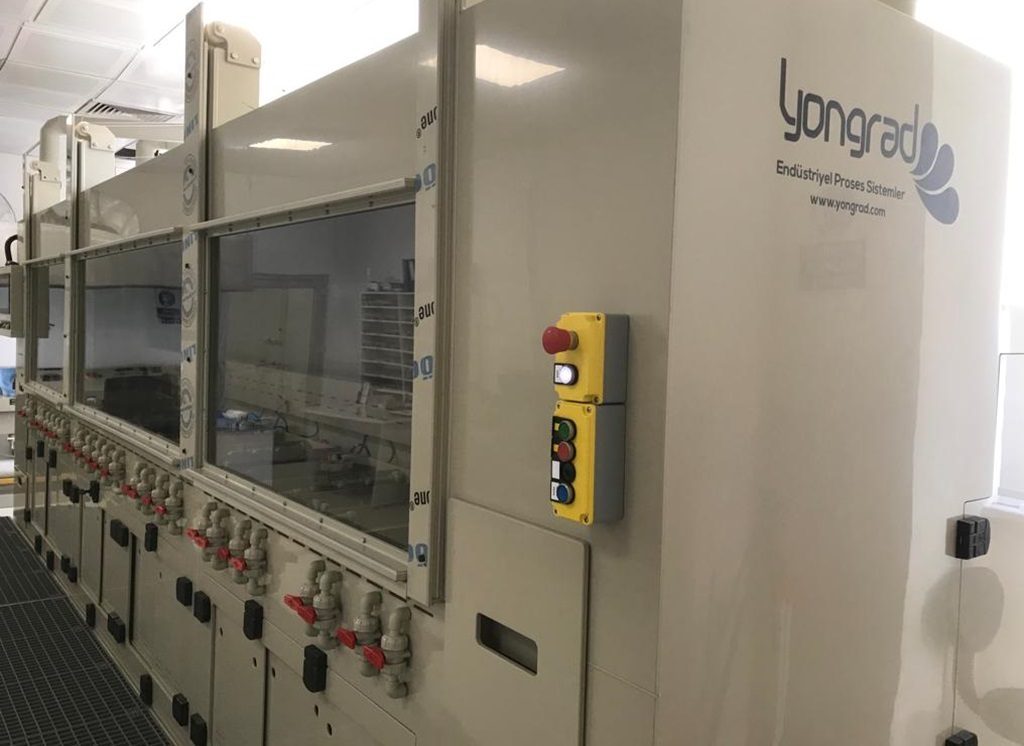
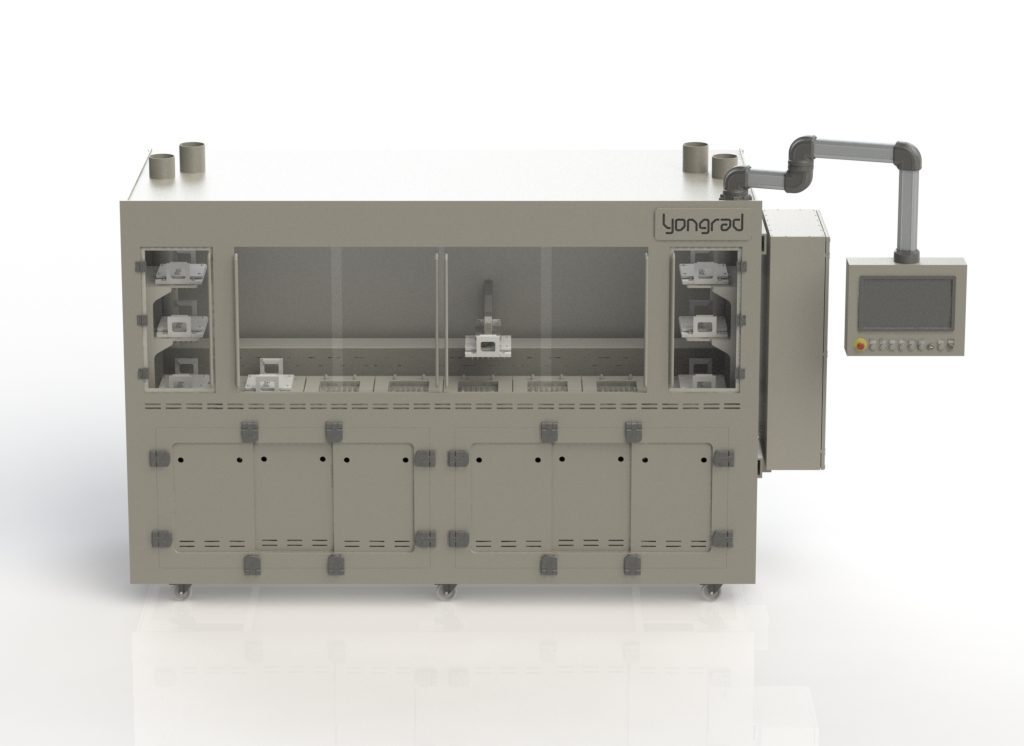
- Transfer Dynamics
- Soft-start pneumatic lift systems that absorb the hydrodynamic shock of immersion.
- Process Control
- PLC autonomy supported by mass flow controllers and precise conductivity and resistivity probes.
- Critical Applications
- Ultrasonic cleaning and drying of defence-industry optical lenses in ultra-pure water, and medium-volume MEMS production lines.
In-line resistivity sensors at the outlet of the cascade rinse baths read the purity continuously. The PLC will not end the cycle until the target — 18 MΩ·cm, for instance — is reached.
Guided by feedback from the concentration sensors, peristaltic or diaphragm dosing pumps replace what the bath has consumed automatically, to millilitre accuracy.
The pneumatic or servo drives of the lift run the immersion on a soft start and stop profile, so no hydrodynamic shock is created.
Fully Automatic Wet Bench SECS/GEM-integrated dark factory systems
Eliminating human intervention entirely and communicating on Industry 4.0 lines through SECS/GEM, these systems represent the summit of closed-loop dark factory technology. In high-volume production every step is managed autonomously end to end, from cassette transfer through chemical replenishment to fault detection.


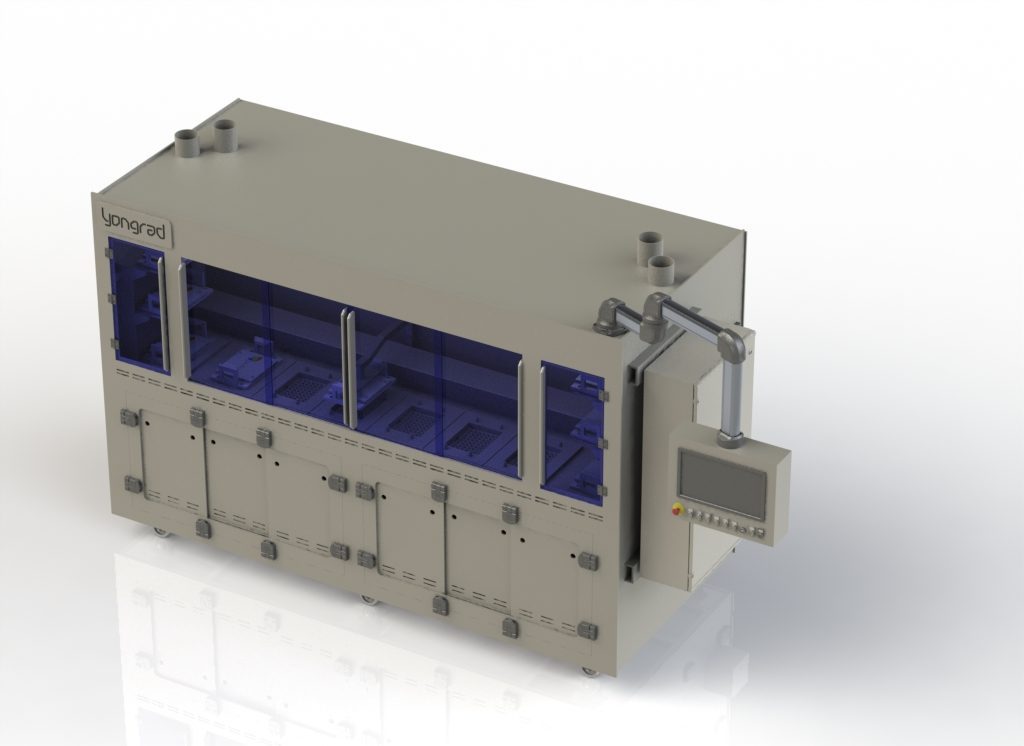

- Robotic Architecture
- Multi-axis servo-controlled robotic hoists and enclosed mechanical housings with particle isolation.
- System Integration
- A micro-climate cabinet with HEPA/ULPA filtration, an integrated chemical management system (CMS) and a SECS-II/GEM interface.
- Critical Applications
- Wet etching and IPA vapour (Marangoni) drying of chips on high-volume 300 mm wafer fabrication lines.
The moving parts — rails and belts — run inside fully sealed enclosures. Those enclosures are held at a constant negative pressure, so any wear particles go straight into the exhaust and never reach the cleanroom air.
The system sends lot number, bath temperature, recipe and sensor data to the MES network in millisecond packets. On any deviation from tolerance it withdraws the affected cassette to a safe holding position and reports a fault code to the control centre.
The optimised V-bottom geometry of the baths and high-capacity pneumatic valves empty them in seconds. Refilling from the pre-heated fresh chemical line happens at the same time, so downtime is minimal.