



Industrial Dosing Units.
Precise chemical injection and fully autonomous liquid transfer.
Zero leakage, from the moment the chemical enters the site to the heart of the process.
The success of an industrial process depends on the chemicals fed into the main lines being dosed to millilitre accuracy, at the right moment and without fluctuation. Yongrad dosing units are intelligent chemical feed stations that inject corrosion inhibitors, acids, alkalis and heavy coagulants into the system independently of human discretion. This ecosystem — from compact dosing tanks to large Camlock-connected tanker unloading cabinets — governs the whole journey of the chemical, from its first arrival on your site to the heart of your process, on a principle of zero leakage and absolute safety.
Dosing Tanks Compact chemical feed units
Space-efficient thermoplastic make-up reactors designed to prepare chemical solutions for the process lines continuously and precisely. Usually scaled individually from 50 to 1,000 litres, these plug-and-play units carry the dosing pump mounts, mixer bridges and calibration lines on a single monoblock body. Unlike plain storage tanks, they are permanently exposed to vibration from the pump strokes, so they are built from extra-reinforced PP or HDPE sheet.

- System Components
-
- Integrated pump shelves: Anti-vibration mounted consoles on which the dosing pumps sit directly on the tank without transmitting their vibration into it.
- PVDF/PP eductor mixers: Acid-resistant, slow-running mixer shafts that stop the prepared solution settling and keep it homogeneous.
- Level and flow sensors: Digital instruments that alarm to the central SCADA if the solution falls below its critical level.
- Industry Applications
-
- Water treatment and cooling towers: Uninterrupted dosing of anti-algal biocides, corrosion inhibitors and chlorine solutions into the network or the cooling water.
- Plating and surface finishing plants: Topping up nickel, zinc or brightener concentrations in the plating baths to the finest accuracy after analysis.
An ordinary drum will not survive pump vibration and the weight of the chemical for long. Yongrad dosing tanks have specific floor slopes that prevent suction cavitation and an outer frame that damps vibration.
The bypass circulation lines or timed slow-speed mixers built into our dosing tanks keep the solution completely homogeneous and fluid around the clock.
Dosing Cabinets Enclosed skid-mounted pump stations
Fully enclosed dosing skids designed to protect the dosing pumps, calibration columns, non-return valves and relief valves from the weather, from mechanical impact and from acid vapour. With a PP or PVC body and a transparent polycarbonate door, these cabinets contain the liquid within themselves if a pump diaphragm ruptures on a high-pressure line, safeguarding both the operator and the factory floor.


- System Components
-
- Transparent splash guards: Polycarbonate front panels that let pump performance be watched from outside yet stand up to a chemical burst.
- Integrated spill containment: A floor sump of 110 % capacity that directs any liquid from a loosened fitting or a leak to a safe outlet.
- Pulsation dampeners: Pressure stabilisers that smooth the pulsing flow of diaphragm pumps and give the main line a perfectly linear chemical injection.
- Industry Applications
-
- Oil, gas and petrochemicals: Injecting downhole corrosion inhibitors and defoamers into the main pipelines at very high pressure.
- Food and beverage plants (CIP lines): Sealed cabinets in which the concentrated nitric acid or caustic used for clean-in-place is dosed without any splashing into the food area.
No. In our cabinets the wet volume, where the pumps move liquid, is physically separated from the dry volume holding the motor and electrics by polymer barriers, and integrated micro-vent channels carry the vapour away.
Yes. Our cabinets are built from UV-stabilised polymers. For sites at risk of frost we also fit explosion-proof heaters inside, so the viscosity of the chemical is maintained even at −20 °C.
IBC Unloading Stations Feed units with automatic changeover
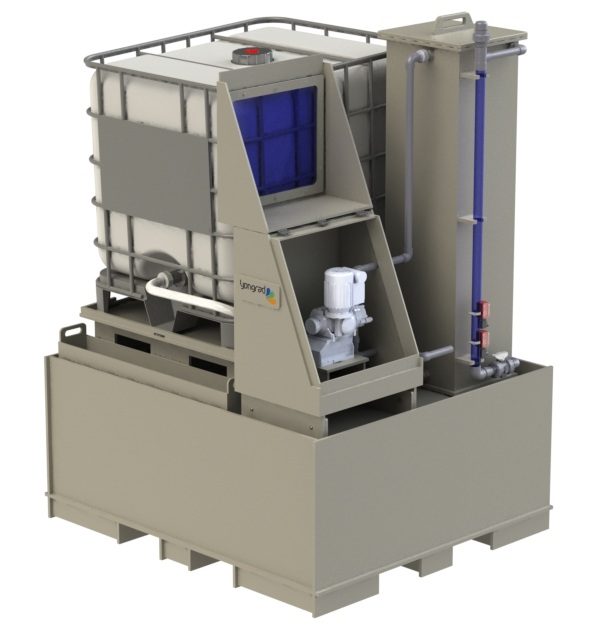
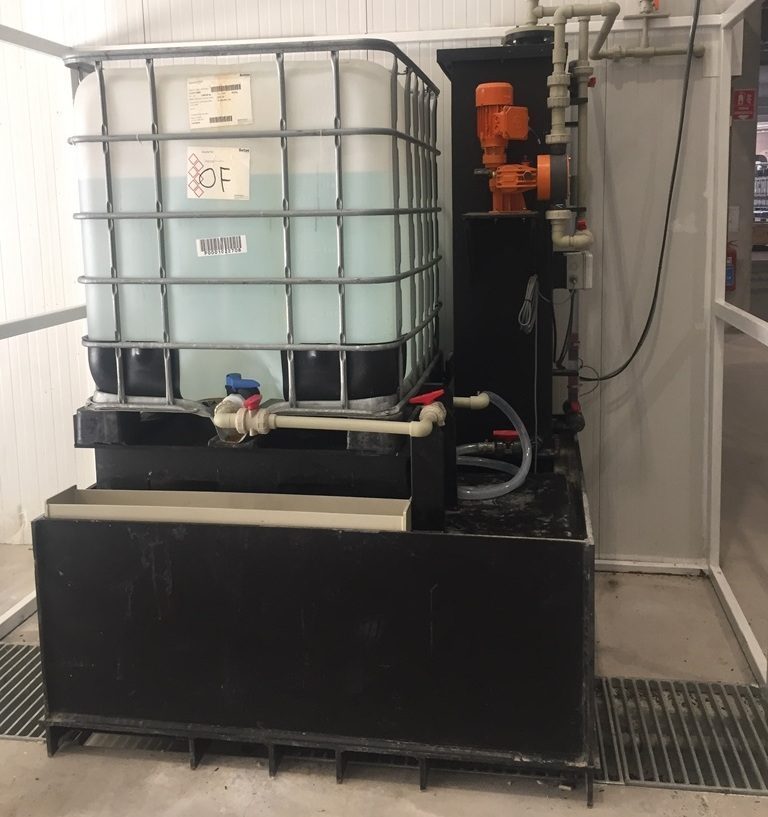
Platforms that provide continuous, safe and autonomous transfer from 1,000-litre IBCs into the main process, at large sites with heavy daily chemical consumption. Ending the cycle of manually opening and closing valves, they stand two or more IBCs on dedicated safety plinths and feed the system without interruption. When one IBC empties, the moment the system draws air it switches automatically to the full one.


- System Components
-
- Auto-changeover manifolds: Intelligent valve groups that use pneumatic PP valves to close the empty IBC line and open the full one within a tenth of a second, so the process is never a moment without chemical.
- Sloped IBC platform and spill sump: Heavy-duty frames set at five degrees so even the last drop leaves the IBC, over a PE/PP containment tray that catches any leak.
- Dry-run protection: Capacitive sensor barriers that stop the transfer pumps instantly when the liquid runs out or air enters the line, preventing the motors burning out.
- Industry Applications
-
- Textile finishing and dyehouses: Autonomous feed in dye kitchens with very high daily consumption of hydrogen peroxide, acetic acid and sodium silicate.
- Paper, pulp and mining industries: Large continuous-flow plants where stopping the process costs millions and uninterrupted pH balancing and bleach feed is mandatory.
In Yongrad stations the hose connections use dry-disconnect couplings. The instant you separate the hose from the IBC, the valves on both sides close automatically — not a single drop reaches the floor.
Degassing chambers built into the manifold and automatic valve synchronisation mean the sensor closes the line the moment it detects the first air; the pump then draws only on the line that is completely full.
Tanker Unloading Cabinets Camlock stations — safety at the first point of contact
The first points of contact, where bulk chemicals are transferred from incoming road tankers into your main storage — and where occupational health, environmental safety and getting the right product into the right tank matter most. Installed on the factory facade or in the goods reception area, these protected cabinets carry industrial Camlock quick couplings, autonomous discharge valves, drip trays and static earthing, turning tanker unloading into a fully controlled procedure.


- System Components
-
- Acid-resistant Camlock couplings: Leak-tight locking couplings that connect the hose in seconds, pressure tested and specified for the aggressiveness of the chemical in PP, PVDF, PTFE-lined or AISI 316L.
- Key or code valve lock-out: A safety layer that prevents the wrong hose being connected to the wrong tanker, physically and digitally, opening the pneumatic valve only when the code or key for that chemical is entered — cross-contamination prevention.
- Static earthing and overfill control: Safety relays that discharge the static between tanker and earth while solvents or flammable chemicals are transferred, and signal the pump to stop when the tank is full.
- Industry Applications
-
- Chemical logistics terminals: Port and bulk loading facilities where dozens of different hazardous chemicals move in and out daily and any splash or spill counts as a disaster.
- Refineries and petrochemical plants: Receiving stations outside the plant for bulk deliveries of sulphuric acid, hydrochloric acid and caustic soda.
Pressure transmitters in the cabinet detect the sudden drop within milliseconds. The fail-close emergency pneumatic valves shut automatically, making it mechanically impossible for the tanker's contents to escape.
Our Camlock stations have integrated drip trays at the base. The few drops released while connecting or disconnecting collect there and are routed through underground lines to safe effluent or recovery tanks. Nothing reaches the environment.